
|
You entered: dwarf planet
 Nova over Thailand
21.11.2016
A nova in Sagittarius is bright enough to see with binoculars. Detected last month, the stellar explosion even approached the limit of naked-eye visibility last week. A classical nova results from a thermonuclear explosion...
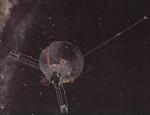 Pioneer 10: The First 7 Billion Miles
25.08.2001
Q: What was made by humans and is 7.3 billion miles away? A: Pioneer 10 -- and 1997 was the 25th anniversary of its launch. Almost 11 light-hours distant, Pioneer 10 is presently about twice as far from the Sun as Pluto, and bound for interstellar space at 28,000 miles per hour.
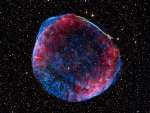 SN 1006 Supernova Remnant
12.07.2014
A new star, likely the brightest supernova in recorded human history, lit up planet Earth's sky in the year 1006 AD. The expanding debris cloud from the stellar explosion, found in the southerly constellation of Lupus, still puts on a cosmic light show across the electromagnetic spectrum.
 SN 1006 Supernova Remnant
1.08.2009
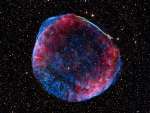
A new star, likely the brightest supernova in recorded human history, lit up planet Earth's sky in the year 1006 AD. The expanding debris cloud from the stellar explosion, found in the southerly constellation of Lupus, still puts on a cosmic light show across the electromagnetic spectrum.
 SN 1006 Supernova Remnant
4.07.2008
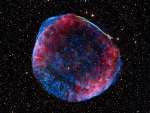
A new star, likely the brightest supernova in recorded human history, lit up planet Earth's sky in the year 1006 AD. The expanding debris cloud from the stellar explosion, found in the southerly constellation of Lupus, still puts on a cosmic light show across the electromagnetic spectrum.
 Sunspot Region 30
18.07.2002
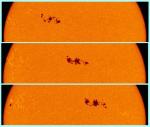
The solar active region designated number 0030 is now appearing on the visible hemisphere of the closest star. Dwarfed by the Sun's disk, the group of sunspots which make up region 30 actually cover an enormous area -- nearly 10 times the size of Earth.
 GK Per: Nova of 1901
5.11.2011
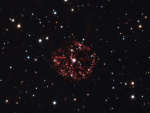
Early in the 20th century, GK Persei briefly became one of the brightest stars in planet Earth's sky, an event known as Nova Persei 1901. Documented in this modern day composite of two images from 2003 and 2011 the ejecta from the explosion, popularly called the Firework Nebula, continues to expand into space.
 Southern Sky at 38,000 Feet
30.01.2021
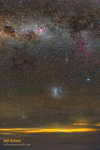
Celestial sights of the southern sky shine above a cloudy planet Earth in this gorgeous night sky view. The scene was captured from an airliner's flight deck at 38,000 feet on a steady westbound ride to Lima, Peru.
 Planetary Nebula Abell 7
23.01.2026
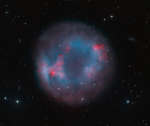
Very faint planetary nebula Abell 7 is about 1,800 light-years distant. It lies just south of Orion in planet Earth's skies toward the constellation Lepus, The Hare. Posing with scattered Milky Way stars, its generally simple spherical shape about 8 light-years in diameter is revealed in this deep telescopic image.
 Planetary Nebula Abell 7
7.03.2025
Very faint planetary nebula Abell 7 is about 1,800 light-years distant. It lies just south of Orion in planet Earth's skies toward the constellation Lepus, The Hare. Surrounded by Milky Way stars...
|
January February March April May June July August |
||||||||||||||||||||||||||||||||||||||||||||||||||||||||