
|
You entered: comet tail
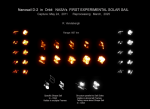 NanoSail D2
2.01.2026
In 2011, on January 20, NASA's NanoSail-D2 unfurled a very thin and very reflective 10 square meter sail becoming the first solar sail spacecraft in low Earth orbit. Often considered the stuff...
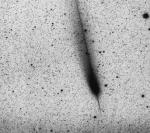 Hale Bopp: A Continuing Tail
20.02.1998
Where is Hale-Bopp now? The Great Comet of 1997, one of the largest and most active comets ever, is outbound about 400 million miles from the sun. Too faint for viewing without telescopes or binoculars, Hale-Bopp is presently positioned in the very southerly constellation of Pictor.
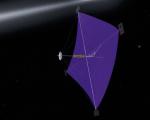 Solar Sail
26.05.2000
Nearly 400 years ago astronomer Johannes Kepler observed comet tails blown by a solar breeze and suggested that vessels might likewise navigate through space using appropriately fashioned sails. It is now widely recognized that...
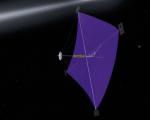 Solar Sail
8.03.2003
Nearly 400 years ago astronomer Johannes Kepler observed comet tails blown by a solar breeze and suggested that vessels might likewise navigate through space using appropriately fashioned sails. It is now widely recognized that...
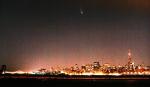 The City Comet
26.03.1997
Undaunted by the artificial glow from one of the most famous urban skylines on Earth, comet Hale-Bopp shines above the city of New York, USA. Photographed on March 23rd, this view from New Jersey...
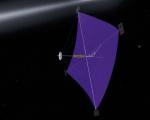 Solar Sail
21.08.2004
Could solar sailing become a future Olympic sport? Nearly 400 years ago astronomer Johannes Kepler observed comet tails blown by a solar breeze and suggested that vessels might likewise navigate through space using appropriately fashioned sails.
 APOD: 2025 March 12 Б NGC 772: The Fiddlehead Galaxy
12.03.2025
Why does this galaxy look like a curly vegetable? The Fiddlehead spiral galaxy likely gets its distorted spiral appearance from a gravitational interaction with its close-by elliptical companion NGC 770, seen just below. Cataloged...
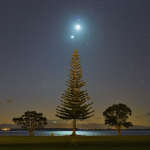 Comet PanSTARRS, Moon, and Venus
23.07.2015
It is the object to the left of the big tree that's generating much recent excitement. If you look closely, there you can see Comet PanSTARRS, complete with two tails. During July, this comet has increased markedly in brightness and has just passed its closest approach to Earth.
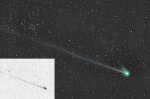 Comet McNaught Passes NGC 1245
17.06.2010
Of the many comets named for discoverer Robert McNaught, the one cataloged as C/2009 R1 is gracing dawn skies for northern hemisphere observers this month. Seen here on June 13th from southern New Mexico, this Comet McNaught's long ion tail sweeps across the telescopic field of view (a negative image is inset).
 ZTF meets ATLAS
10.02.2023
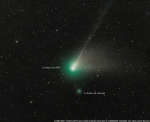
Fading as it races across planet Earth's northern skies comet C/2022 E3 (ZTF) shares this telescopic frame with comet C/2022 U2 (ATLAS). Captured on the night of February 6 from a garden observatory in Germany's Bavarian Forest, the starry field of view toward the constellation Auriga spans about 2.5 degrees.
|
January February March April May June July August September |
|||||||||||||||||||||||||||||||||||||||||||||||||