
|
You entered: camera
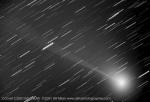 C 2001 A2 (LINEAR): Comet
5.07.2001
Comet C/2001 A2 (LINEAR) has crossed the celestial equator and is heading north. Outward bound, this primordial piece of the solar system is still just visible to the unaided eye and can now be sighted by northern hemisphere skygazers as it moves through the constellation Pisces.
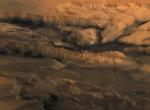 Melas, Candor, and Ophir: Valleys of Mariner
17.02.2005
First imaged by the Mariner 9 spacecraft, Valles Marineris, the grand canyon of Mars, is a system of enormous depressions or chasmas that stretch some 4,000 kilometers along the Martian equator. Looking north over the canyon's central regions, dark Melas Chasma lies in the foreground of this spectacular perspective view.
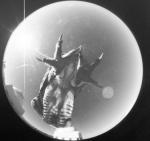 A New Constellation Takes Hold
1.04.2003
A new constellation has taken hold of the sky, much to the surprise of many sky gazers. The constellation of Ollie the Owl has suddenly started dominating the southern hemisphere, as shown above. The constellation is taking the place of Wrinkles the Rhinoceros, who was unexpectedly voted off they sky by the other constellations.
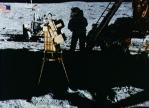 The First Lunar Observatory
11.11.2000
The first, and so far only, lunar astronomical observatory was deployed by the Apollo 16 crew in 1972. The Far Ultraviolet Camera / Spectrograph used a 3-inch diameter Schmidt telescope to photograph the Earth, nebulae, star clusters, and the Large Magellanic Cloud.
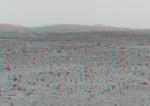 The Hills of Mars
8.01.2004
Distant hills rise above a rocky, windswept plain in this sharp stereo scene from the Spirit rover on Mars. When viewed with red/blue glasses, the picture combines left and right images from Spirit's high resolution panoramic camera to yield a dramatic 3D perspective.
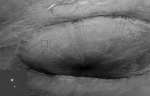 Descent of the Phoenix
30.05.2008
In this sweeping view, the 10 kilometer-wide crater Heimdall lies on the north polar plains of Mars. But the bright spot highlighted in the inset is the Phoenix lander parachuting toward the surface. The amazing picture was captured on May 25th by the HiRISE camera onboard the Mars Reconnaissance Orbiter.
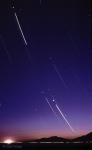 Trailing Planets
10.05.2002
Positioning his camera and tripod on planet Earth, near Maricopa, Arizona, USA, astrophotographer Joe Orman created this trailing display of the ongoing sky-full-of-planets on May 3rd. He initially captured the grouping in a 20 second long time exposure recording the positions of the bright planets and stars.
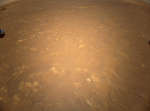 Perseverance from Ingenuity
1.05.2021
Flying at an altitude of 5 meters (just over 16 feet), on April 25 the Ingenuity helicopter snapped this sharp image. On its second flight above the surface of Mars, its color camera was looking back toward Ingenuity's current base at Wright Brothers Field and Octavia E.
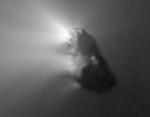 Halley s Nucleus: An Orbiting Iceberg
5.08.2000
What does a comet nucleus look like? Formed from the primordial stuff of the solar system, it is thought to resemble a very dirty iceberg. But for active comets, telescopic images only reveal the surrounding cloud of gas and dust, the comet's coma, and the characteristic cometary tails.
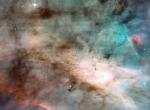 In the Center of the Omega Nebula
1.05.2002
In the depths of the dark clouds of dust and molecular gas known as the Omega Nebula, stars continue to form. The above image from the Hubble Space Telescope's newly installed Advanced Camera for Surveys shows unprecedented detail in the famous star-forming region.
|
January February March April May June July August September October November |
||||||||||||||||||||||||||||||||||||||||||||||||||||||||