
|
You entered: X-ray source
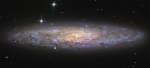 NGC 253: Dusty Island Universe
22.03.2018
Shiny NGC 253 is one of the brightest spiral galaxies visible, and also one of the dustiest. Some call it the Silver Dollar Galaxy for its appearance in small telescopes, or just the Sculptor Galaxy for its location within the boundaries of the southern constellation Sculptor.
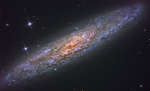 NGC 253: Dusty Island Universe
21.11.2009
Shiny NGC 253 Galaxy, is one of the brightest spiral galaxies visible, and also one of the dustiest. Some call it the Silver Dollar Galaxy for its appearance in small telescopes, or just the Sculptor Galaxy for its location within the boundaries of the southern constellation Sculptor.
 NGC 253: Close Up
19.05.2011
This dusty island universe is one of the brightest spiral galaxies in planet Earth's sky. Seen nearly edge-on, NGC 253 is only 13 million light-years away, the largest member of the Sculptor Group of galaxies, neighbor to our own local galaxy group.
 APOD: 2024 August 21 Б Fermis 12 year All Sky Gamma ray Map
21.08.2024
Forget X-ray vision Б imagine what you could see with gamma-ray vision! The featured all-sky map shows what the universe looks like to NASA's Fermi Gamma-ray Space Telescope. Fermi sees light with energies about a billion times what the human eye can see, and the map combines 12 years of Fermi observations.
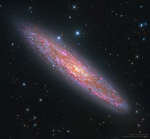 NGC 253: The Silver Coin Galaxy
14.04.2020
NGC 253 is one of the brightest spiral galaxies visible, but also one of the dustiest. Dubbed the Silver Coin for its appearance in smalltelescopes, it is more formally known as the Sculptor Galaxy for its location within the boundaries of the southern constellation Sculptor.
 Swift RocketCam
24.12.2004
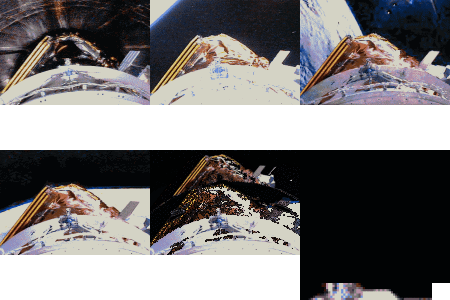
A forward-facing RocketCam (TM) mounted inside the payload fairing of a Delta II rocket captured these dramatic video frames on November 20th -- as the Swift satellite observatory journeyed to an orbit 600 kilometers above planet Earth. Some frames were interpolated to correct for transmission problems.
 Explosions Discovered Near Galactic Center
28.02.1996
Tremendous explosions near the center of our Galaxy were discovered just this past December and are being announced today by a paper in Nature and a press conference at NASA. Bursts like these have...
 Gamma-Ray Burster
19.03.1997
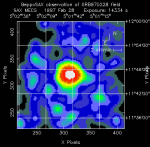
What and where are the Gamma-Ray Bursters? Since their discovery in the early 1970s, nobody has been able to explain the cause of mysterious flashes of gamma rays that come from seemingly random directions on the sky.
 SN 1006: Pieces of the Cosmic Ray Puzzle
2.12.2000
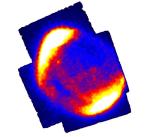
Research balloon flights conducted in 1912 by Austrian physicist Victor Hess revealed that the Earth was constantly bombarded by high energy radiation from space - which came to be called "Cosmic Rays". What are Cosmic Rays and where do they come from?
 SN 1006 Supernova Remnant
4.07.2008
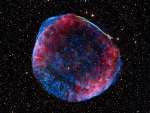
A new star, likely the brightest supernova in recorded human history, lit up planet Earth's sky in the year 1006 AD. The expanding debris cloud from the stellar explosion, found in the southerly constellation of Lupus, still puts on a cosmic light show across the electromagnetic spectrum.
|
January February March April May June July August September October |
|||||||||||||||||||||||||||||||||||||||||||||||||