
|
You entered: time
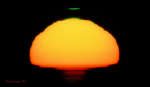 A Green Flash from the Sun
4.06.2014
Many think it is just a myth. Others think it is true but its cause isn't known. Adventurers pride themselves on having seen it. It's a green flash from the Sun. The truth is the green flash does exist and its cause is well understood.
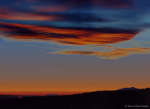 Mercury on the Horizon
17.07.2016
Have you ever seen the planet Mercury? Because Mercury orbits so close to the Sun, it never wanders far from the Sun in Earth's sky. If trailing the Sun, Mercury will be visible low on the horizon for only a short while after sunset.
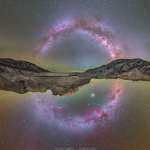 The Complete Galactic Plane: Up and Down
13.03.2018
Is it possible to capture the entire plane of our galaxy in a single image? Yes, but not in one exposure -- and it took some planning to do it in two. The top part of the featured image is the night sky above Lebanon, north of the equator, taken in 2017 June.
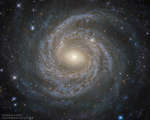 APOD: 2020 August 16 Б NGC 6814: Grand Design Spiral Galaxy from Hubble
16.08.2020
In the center of this serene stellar swirl is likely a harrowing black-hole beast. The surrounding swirl sweeps around billions of stars which are highlighted by the brightest and bluest. The breadth and beauty of the display give the swirl the designation of a grand design spiral galaxy.
 Rigel Wide
7.04.2023
Brilliant, blue, supergiant star Rigel marks the foot of Orion the Hunter in planet Earth's night. Designated Beta Orionis, it's at the center of this remarkably deep and wide field of view.
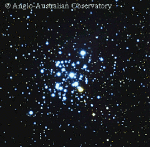 NGC 3293: A Bright Young Open Cluster
23.08.1996
Hot Blue stars shine brightly in this beautiful, recently formed galactic or "open" star cluster. Open cluster NGC 3293 is located in the constellation Carina, lies at a distance of about 8000 light years, and has a particularly high abundance of these young bright stars.
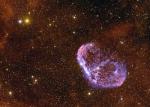 A Crescent Nebula Star Field
15.04.2003
What caused the Crescent Nebula? Looking like an emerging space cocoon, the Crescent Nebula, visible on the right, was created by the brightest star in its center. A leading progenitor hypothesis has the Crescent Nebula beginning to form about 250,000 years ago.
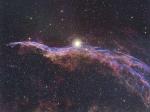 NGC 6960: The Witchs Broom Nebula
2.03.2004
Ten thousand years ago, before the dawn of recorded human history, a new light must suddenly have appeared in the night sky and faded after a few weeks. Today we know this light was an exploding star and record the colorful expanding cloud as the Veil Nebula.
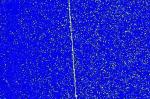 An Anomalous SETI Signal
7.03.2004
No one knows for sure what caused this signal. There is a slight possibility that it just might originate from an extraterrestrial intelligence. The bright colors on the blue background indicate that an anomalous signal was received here on Earth by a radio telescope involved in a Search for Extraterrestrial Intelligence (SETI).
 Look West for a NEAT Comet
7.05.2004
On May 5th, while scanning western skies after sunset, astronomer Jimmy Westlake was glad to spot a visitor from the outer solar system, Comet NEAT, with his own eyes. Taken with a normal lens...
|
January February March April May June July August September |
|||||||||||||||||||||||||||||||||||||||||||||||||