
|
You entered: nearest stars
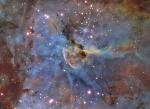 Eta and Keyhole in the Carina Nebula
16.03.2006
South is toward the top in this colorful close-up view of the Great Carina Nebula (NGC 3372), famous star-forming region of the southern sky. Covering an area surrounding the dusty Keyhole Nebula (NGC 3324)...
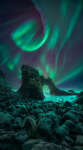 APOD: 2023 January 11 Б Spiral Aurora over Iceland
11.01.2023
The scene may look like a fantasy, but it's really Iceland. The rock arch is named Gatklettur and located on the island's northwest coast. Some of the larger rocks in the foreground span a meter across. The fog over the rocks is really moving waves averaged over long exposures.
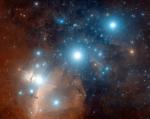 Alnitak, Alnilam, Mintaka
13.10.2005
Alnitak, Alnilam, and Mintaka, are the bright bluish stars from east to west (left to right) along the diagonal in this gorgeous cosmic vista. Otherwise known as the Belt of Orion, these three blue supergiant stars are hotter and much more massive than the Sun.
 Alnitak, Alnilam, Mintaka
29.12.2006
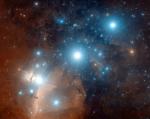
Alnitak, Alnilam, and Mintaka, are the bright bluish stars from east to west (left to right) along the diagonal in this gorgeous cosmic vista. Otherwise known as the Belt of Orion, these three blue supergiant stars are hotter and much more massive than the Sun.
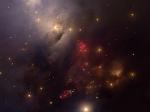 In the Center of Reflection Nebula NGC 1333
21.05.2007
The dust is so thick in the center of NGC 1333 that you can hardly see the stars forming. Conversely, the very dust clouds that hide the stars also reflects their optical light, giving NGC 1333's predominantly blue glow the general designation of a reflection nebula.
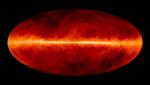 A Sky Full Of Hydrogen
13.01.2001
Interstellar space is filled with extremely tenuous clouds of gas which are mostly Hydrogen. The neutral hydrogen atom (HI in astronomer's shorthand) consists of 1 proton and 1 electron. The proton and electron spin like tops but can have only two orientations; spin axes parallel or anti-parallel.
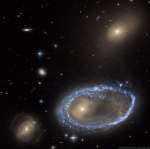 Ring Galaxy AM 0644 741
28.07.2021
The rim of the large blue galaxy at the right is an immense ring-like structure 150,000 light years in diameter composed of newly formed, extremely bright, massive stars. AM 0644-741 is known as a ring galaxy and was caused by an immense galaxy collision.
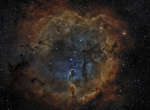 IC 1396: Emission Nebula in Cepheus
20.07.2017
Stunning emission nebula IC 1396 mixes glowing cosmic gas and dark dust clouds in the high and far off constellation of Cepheus. Energized by the bright central star seen here, this star forming region sprawls across hundreds of light-years, spanning over three degrees on the sky while nearly 3,000 light-years from planet Earth.
 Comet Heart and Soul
23.08.2018
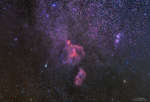
The greenish coma of comet 21P/Giacobini-Zinner stands out at the left of this telephoto skyscape spanning over 10 degrees toward the northern constellations Cassiopeia and Perseus. Captured on August 17, the periodic comet is the known parent body of the upcoming Draconid meteor shower.
 IC 1396: Emission Nebula in Cepheus
5.08.2012
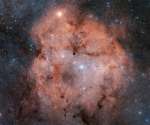
Stunning emission nebula IC 1396 mixes glowing cosmic gas and dark dust clouds in the high and far off constellation of Cepheus. Energized by the bright, bluish central star seen here, this star forming region sprawls across hundreds of light-years -- spanning over three degrees on the sky while nearly 3,000 light-years from planet Earth.
|
January February March April May June July August September October |
|||||||||||||||||||||||||||||||||||||||||||||||||