
|
You entered: Solar System
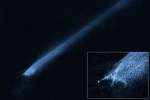 P2010 A2: Unusual Asteroid Tail Implies Powerful Collision
3.02.2010
What is this strange object? First discovered on ground based LINEAR images on January 6, the object appeared unusual enough to investigate further with the Hubble Space Telescope last week. Pictured above, what Hubble saw indicates that P/2010 A2 is unlike any object ever seen before.
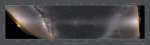 Zodiacal Light Panorama
5.04.2012
Sweeping from the eastern to western horizon, this 360 degree panorama follows the band of zodiacal light along the solar system's ecliptic plane. Dust scattering sunlight produces the faint zodiacal glow that spans...
 Venus at Night in Infrared from Akatsuki
30.01.2018
Why is Venus so different from Earth? To help find out, Japan launched the robotic Akatsuki spacecraft which entered orbit around Venus late in 2015 after an unplanned five-year adventure around the inner Solar System.
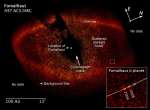 Fomalhaut b
14.11.2008
Fomalhaut (sounds like "foam-a-lot") is a bright, young, star, a short 25 light-years from planet Earth in the direction of the constellation Piscis Austrinus. In this sharp composite from the Hubble Space Telescope, Fomalhaut...
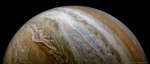 A Jupiter Vista from Juno
23.11.2020
Why do colorful cloud bands encircle Jupiter? Jupiter's top atmospheric layer is divided into light zones and dark belts that go all the way around the giant planet. It is high horizontal winds -- in excess of 300 kilometers per hour -- that cause the zones to spread out planet-wide.
 Earth Nears Asteroid Toutatis
1.10.2004
On Wednesday, September 29, the Earth came within one million miles of the asteroid Toutatis -- the closest predicted aproach of our fair planet to a sizable asteroid or comet in this century. Coming within...
 An Atlas V Rocket Launches OSIRIS REx
17.10.2016
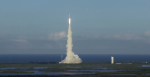
Have you ever seen a rocket launched into the Solar System? Last month a large Atlas V rocket blasted off from Launch Complex 41 in Florida carrying the ORISIX-REx spacecraft. This robotic spacecraft will attempt to land on Asteroid Bennu and return some of its soil to Earth.
 APOD: 2024 December 22 Б The Local Fluff
22.12.2024
The stars are not alone. In the disk of our Milky Way Galaxy, about 10 percent of visible matter is in the form of gas called the interstellar medium (ISM). The ISM is not uniform and shows patchiness even near our Sun.
 MESSENGER s Last Day on Mercury
1.05.2025
The first to orbit inner planet Mercury, the MESSENGER spacecraft came to rest on this region of Mercury's surface on April 30, 2015. Constructed from MESSENGER image and laser altimeter data, the projected scene looks north over the northeastern rim of the broad, lava filled Shakespeare basin.
 The Brightest Spot on Ceres
11.12.2015
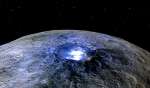
Dwarf planet Ceres is the largest object in the Solar System's main asteroid belt with a diameter of about 950 kilometers. Exploring Ceres from orbit since March, the Dawn spacecraft's camera...
|
January February March April May June July August September |
|||||||||||||||||||||||||||||||||||||||||||||||||