
|
You entered: surface
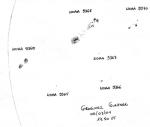 Islands in the Photosphere
25.10.2003
Awash in a sea of plasma and anchored in magnetic fields, sunspots are planet-sized, dark islands in the solar photosphere, the bright surface of the Sun. Before the enlightened(!) age of cameras, solar observers created detailed drawings of sunspots as they changed and progressed across the visible solar disk.
 Spiral Eddies On Planet Earth
16.01.1999
Can you identify this wispy stellar nebula? How many light-years from Earth did you say? Resembling a twisting cloud of gas and dust between the stars this swirling form is actually close by - a spiral eddy formed near the North Atlantic Gulf Stream off the East coast of the U. S.
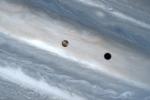 Io Shadow
23.04.1999
Orbiting Jupiter once every 43 hours, the volcanic moon Io cruises 500,000 kilometers above swirling, banded cloud-tops. Orbiting Earth once every 1.5 hours, the Hubble Space Telescope watched as Io accompanied by its shadow crossed the face of the reigning gas giant planet in 1997.
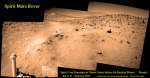 The Last Panorama of the Spirit Rover on Mars
30.05.2011
This is the last thing that the Spirit rover on Mars ever saw. Operating years beyond original expectations, Spirit eventually got mired in martian dirt and then ran out of power when investigating the unusual Home Plate surface feature on Mars.
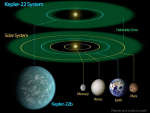 APOD: 2011 December 7 Kepler 22b: An Almost Earth Orbiting an Almost Sun
7.12.2011
Its the closest match to Earth that has yet been found. Recently discovered planet Kepler 22b has therefore instantly become the best place to find life outside our Solar System. The planet's host...
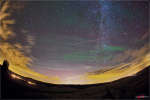 Airglow Over Germany
5.09.2012
Does air glow? It does, but it is usually hard to see. When conditions are right, however, a faint glow about 90 kilometers up can be observed, most easily with a wide-angle long-duration camera exposure.
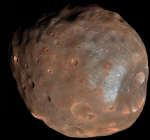 Phobos: Doomed Moon of Mars
28.10.2012
This moon is doomed. Mars, the red planet named for the Roman god of war, has two tiny moons, Phobos and Deimos, whose names are derived from the Greek for Fear and Panic. These...
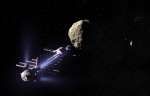 Gravitational Tractor
21.02.2013
How would you change the course of an Earth-threatening asteroid? One possibility - a massive spacecraft that uses gravity as a towline - is illustrated in this artist's vision of a gravitational tractor in action.
 A Hole in Mars
9.03.2014
What created this unusual hole in Mars? The hole was discovered by chance in 2011 on images of the dusty slopes of Mars' Pavonis Mons volcano taken by the HiRISE instrument aboard the robotic Mars Reconnaissance Orbiter currently circling Mars.
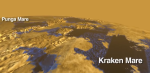 Soaring over Titan
23.11.2014
What would it look like to fly over Titan? Radar images from NASA's robotic Cassini satellite in orbit around Saturn have been digitally compiled to simulate such a flight. Cassini has swooped past Saturn's cloudiest moon several times since it arrived at the ringed planet in 2004.
|
January February March April May June July August September October |
|||||||||||||||||||||||||||||||||||||||||||||||||