
|
You entered: dust cloud
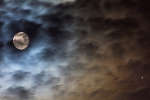 Moons Near Jupiter
23.05.2019
On May 20, a nearly Full Moon and Jupiter shared this telephoto field of view. Captured when a passing cloud bank dimmed the moonlight, the single exposure reveals the familiar face of our fair planet's own large natural satellite, along with bright Jupiter (lower right) and some of its Galilean moons.
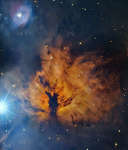 Alnitak and the Flame Nebula
12.04.2021
What lights up the Flame Nebula? Fifteen hundred light years away towards the constellation of Orion lies a nebula which, from its glow and dark dust lanes, appears, on the left, like a billowing fire. But fire, the rapid acquisition of oxygen, is not what makes this Flame glow.
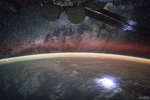 Space Station Vista: Planet and Galaxy
18.01.2017
If you could circle the Earth aboard the International Space Station, what might you see? Some amazing vistas, one of which was captured in this breathtaking picture in mid-2015. First, visible at the top, are parts of the space station itself including solar panels.
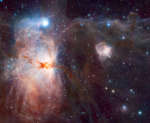 The Flame Nebula in Infrared
12.01.2010
What lights up the Flame Nebula? Fifteen hundred light years away towards the constellation of Orion lies a nebula which, from its glow and dark dust lanes, appears, on the left, like a billowing fire. But fire, the rapid acquisition of oxygen, is not what makes this Flame glow.
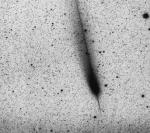 Hale Bopp: A Continuing Tail
20.02.1998
Where is Hale-Bopp now? The Great Comet of 1997, one of the largest and most active comets ever, is outbound about 400 million miles from the sun. Too faint for viewing without telescopes or binoculars, Hale-Bopp is presently positioned in the very southerly constellation of Pictor.
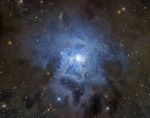 NGC 7023: The Iris Nebula
3.09.2021
These cosmic clouds have blossomed 1,300 light-years away, in the fertile starfields of the constellation Cepheus. Called the Iris Nebula, NGC 7023 is not the only nebula to evoke the imagery of flowers.
 NGC 7023: The Iris Nebula
2.09.2023
These cosmic clouds have blossomed 1,300 light-years away in the fertile starfields of the constellation Cepheus. Called the Iris Nebula, NGC 7023 is not the only nebula to evoke the imagery of flowers.
 NGC 7023: The Iris Nebula
25.07.2024
These cosmic clouds have blossomed 1,300 light-years away in the fertile starfields of the constellation Cepheus. Called the Iris Nebula, NGC 7023 is not the only nebula to evoke the imagery of flowers.
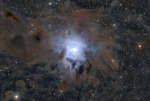 NGC 7023: The Iris Nebula
16.01.2026
These cosmic clouds have blossomed 1,300 light-years away in the fertile starfields of the constellation Cepheus. Called the Iris Nebula, NGC 7023 is not the only nebula to evoke the imagery of flowers.
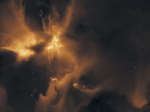 A Particle Beam Jet forms HH 24
4.02.2014
If you visit HH 24, don't go near the particle beam jet. This potential future travel advisory might be issued because the powerful jet likely contains electrons and protons moving hundreds of kilometers per second.
|
January February March April May June July August September |
|||||||||||||||||||||||||||||||||||||||||||||||||