
|
You entered: dark
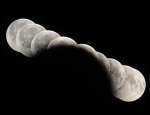 Earth s Shadow
20.08.2008
The dark, inner shadow of planet Earth is called the umbra. Shaped like a cone extending into space, the umbra has a circular cross section that can be most easily seen during a lunar eclipse. For example, last Saturday the Full Moon slid across the northern edge of the umbra.
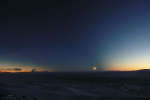 Eclipse Shadow Cone Over Patagonia
4.08.2010
Sometimes, during a total eclipse of the Sun, a strange shadow of darkness can be seen stretching off into the distance. Called shadow cones, they are visible because the Earth's atmosphere is not completely transparent, scattering sunlight and hence appearing blue during the day.
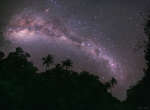 Mangaia's Milky Way
24.09.2011
From Sagittarius to Carina, the Milky Way Galaxy shines in this dark night sky above planet Earth's lush island paradise of Mangaia. Familiar to denizens of the southern hemisphere, the gorgeous skyscape includes the bulging galactic center at the upper left and bright stars Alpha and Beta Centauri just right of center.
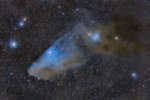 IC 4592: The Blue Horsehead Reflection Nebula
2.04.2013
Do you see the horse's head? What you are seeing is not the famous Horsehead nebula toward Orion but rather a fainter nebula that only takes on a familiar form with deeper imaging. The main part of the above imaged molecular cloud complex is a reflection nebula cataloged as IC 4592.
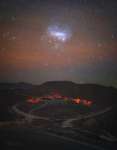 Under the Galaxy
13.10.2017
The Large Magellanic Cloud, a satellite galaxy of the Milky Way, stands above the southern horizon in this telephoto view from Las Campanas Observatory, planet Earth. In the dark September skies of the Chilean Atacama desert, the small galaxy has an impressive span of about 10 degrees or 20 Full Moons.
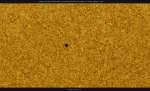 Mercury in Silhouette
13.11.2019
The small, dark, round spot in this solar close up is planet Mercury. In the high resolution telescopic image, a colorized stack of 61 sharp video frames, a turbulent array of photospheric convection cells tile the bright solar surface. Mercury's more regular silhouette still stands out though.
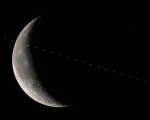 Trifecta at Twilight
20.02.2020
On February 18, as civil twilight began in northern New Mexico skies, the International Space Station, a waning crescent Moon, and planet Mars for a moment shared this well-planned single field of view. From...
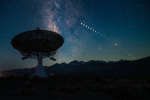 Mid Eclipse and Milky Way
27.05.2021
May's perigee Full Moon slid through Earth's shadow yesterday entertaining night skygazers in regions around the Pacific. Seen from western North America, it sinks toward the rugged Sierra Nevada mountain range in this time-lapse series of the total lunar eclipse.
 APOD: 2024 April 10 Б Planets Around a Total Eclipse
10.04.2024
What wonders appear when the Moon blocks the Sun? For many eager observers of MondayБs total eclipse of the Sun, the suddenly dark sky included the expected corona and two (perhaps surprise) planets: Venus and Jupiter.
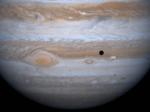 Jupiter, Io, and Shadow
26.12.2000
Just as planets orbit our Sun, Jupiter's Moons orbit Jupiter. Pictured above is the closest of Jupiter's Galilean Satellites, Io, superposed in front of the giant planet it circles. To the left of Io is a dark spot that is its own shadow.
|
January February March April May June July August September |
|||||||||||||||||||||||||||||||||||||||||||||||||