
|
You entered: sky
 APOD: 2024 December 10 Б The Great Meteor Storm of 1833
10.12.2024
It was a night of 100,000 meteors. The Great Meteor Storm of 1833 was perhaps the most impressive meteor event in recent history. Best visible over eastern North America during the pre-dawn hours...
 APOD: 2025 August 14 Б M13: The Great Globular Cluster in Hercules
14.08.2025
In 1716, English astronomer Edmond Halley noted, "This is but a little Patch, but it shews itself to the naked Eye, when the Sky is serene and the Moon absent." Of course...
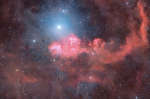 Ghosts in Cassiopeia
31.10.2025
Halloween is an astronomy holiday and spooky shapes always seem to lurk in planet Earth's night skies. In fact, near the center of this telescopic view toward the constellation Cassiopeia these swept-back interstellar clouds IC 59 (left) and IC 63 look ghostly on a cosmic scale.
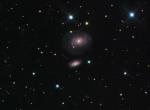 NGC 1 and NGC 2
19.08.2005
Beautiful nebulae, clusters, and galaxies that grace planet Earth's night sky are often known by their New General Catalog designation or NGC number. That classic listing was compiled by John Louis Emil Dreyer, remarkable director of the Armagh Observatory from 1882 to 1916.
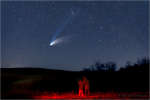 Hale Bopp: The Great Comet of 1997
13.10.2013
Sixteen years ago, Comet Hale-Bopp rounded the Sun and offered a dazzling spectacle in planet Earth's night. This stunning view, recorded shortly after the comet's 1997 perihelion passage, features the memorable tails of Hale-Bopp -- a whitish dust tail and blue ion tail.
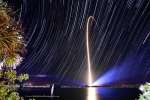 Rocket Streak and Star Trails
30.01.2014
Fixed to a tripod and looking east across the Kennedy Space Center's Turn Basin, a camera captured these star trails as a series of short exposures over a three hour period on the evening of January 23rd.
 APOD: 2024 May 12 Б Red Aurora over Poland
12.05.2024
Northern lights don't usually reach this far south. Magnetic chaos in the Sun's huge Active Region 3664, however, produced a surface explosion that sent a burst of electrons, protons, and more massive, charged nuclei into the Solar System.
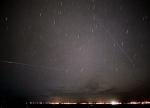 Mir Flares Farewell
23.03.2001
Streaking low across the western horizon after sunset, the Russian Mir space station makes a final pass through the evening sky above the coastal city of Salvador, Brazil. In this 5 minute 20 second time exposure made with ASA 800 film and a wide-angle lens on March 19, setting stars leave short, almost vertical trails.
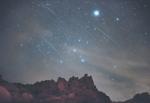 Leonids Over Joshua Tree National Park
5.11.2002
This year's Leonid Meteor Shower is predicted to have two peaks, like last year's. The first peak should come at about 04:00 hours Universal Time (UT) on November 19 and be primarily visible from Western Europe before sunrise.
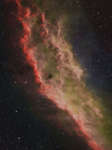 NGC 1499: The California Nebula
2.03.2011
What's California doing in space? Drifting through the Orion Arm of the spiral Milky Way Galaxy, this cosmic cloud by chance echoes the outline of California on the west coast of the United States.
|
January February March April May June July August September October |
|||||||||||||||||||||||||||||||||||||||||||||||||