
|
You entered: clouds
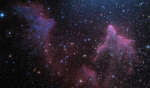 IC 59 and IC 63 in Cassiopeia
26.10.2018
These bright rims and flowing shapes look ghostly on a cosmic scale. A telescopic view toward the constellation Cassiopeia, the colorful (zoomable) skyscape features the swept-back, comet-shaped clouds IC 59 (left) and IC 63.
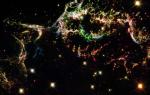 Recycling Cassiopeia A
12.07.2002
For billions of years, massive stars in our Milky Way Galaxy have lived spectacular lives. Collapsing from vast cosmic clouds, their nuclear furnaces ignite and create heavy elements in their cores. After a few million years, the enriched material is blasted back into interstellar space where star formation begins anew.
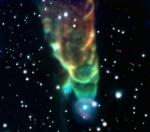 Cosmic Tornado HH 49 50
3.02.2006
Light-years in length, this cosmic tornado is actually a powerful jet cataloged as HH (Herbig-Haro) 49/50 blasting down from the top of a Spitzer Space Telescope view. Though such energetic outflows are well known...
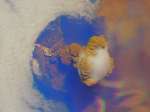 Sarychev Peak Volcano in Stereo
25.06.2009
From 400 kilometers above planet Earth, the Expedition 20 Crew onboard the International Space Station (ISS) was able to witness a remarkable event from a remarkable vantage point -- the June 12 eruption of the Sarychev Peak Volcano. The active volcano is located in Russia's Kuril Island chain, stretching to the northeast of Japan.
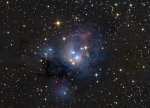 Young Suns of NGC 7129
27.10.2011
Young suns still lie within dusty NGC 7129, some 3,000 light-years away toward the royal constellation Cepheus. While these stars are at a relatively tender age, only a few million years old, it is likely that our own Sun formed in a similar stellar nursery some five billion years ago.
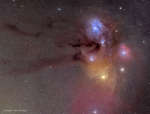 The Dark River to Antares
21.02.2015
Connecting the Pipe Nebula to the colorful region near bright star Antares is a dark cloud dubbed the Dark River, flowing from the picture's left edge. Murky looking, the Dark River's appearance is caused by dust obscuring background starlight, although the dark nebula contains mostly hydrogen and molecular gas.
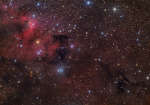 The Light, the Dark, and the Dusty
11.06.2015
This colorful skyscape spans about three full moons (1.5 degrees) across nebula rich starfields along the plane of our Milky Way Galaxy in the royal northern constellation Cepheus. Near the edge of the region...
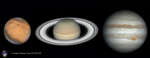 Three Planets from Pic du Midi
2.06.2016
Seen any planets lately? All three planets now shining brightly in the night sky are imaged in these panels, captured last week with the 1 meter telescope at Pic du Midi Observatory in the French Pyrenees.
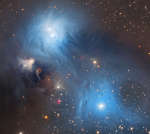 Stars and Dust in Corona Australis
18.10.2017
Blue dust clouds and young, energetic stars inhabit this telescopic vista, less than 500 light-years away toward the northern boundary of Corona Australis, the Southern Crown. The dust clouds effectively block light from more distant background stars in the Milky Way.
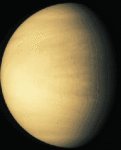 Venus: Earth's Cloudy Twin
23.09.1996
If Venus weren't so cloudy it would be more similar to Earth. This picture by the Galileo spacecraft shows just how cloudy Venus is. Venus is very similar to Earth in size and mass - and so is sometimes referred to as Earth's sister planet - but Venus has a quite different climate.
|
January February March April May June July August September October November |
||||||||||||||||||||||||||||||||||||||||||||||||||||||||