
|
You entered: Solar System
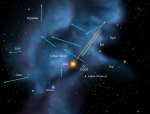 The Local Fluff
24.09.2013
The stars are not alone. In the disk of our Milky Way Galaxy about 10 percent of visible matter is in the form of gas, called the interstellar medium (ISM). The ISM is not uniform, and shows patchiness even near our Sun.
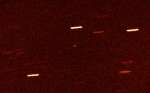 A 2017 U1: An Interstellar Visitor
3.11.2017
Traveling at high velocity along an extreme hyperbolic orbit and making a hairpin turn as it swung past the Sun, the now designated A/2017 U1 is the first known small body from interstellar space.
 Halley Dust, Mars Dust, and Milky Way
12.05.2023
Grains of cosmic dust streaked through night skies in early May. Swept up as planet Earth plowed through the debris streams left behind by periodic Comet Halley, the annual meteor shower is known as the Eta Aquarids. This year, the Eta Aquarids peak was visually hampered by May's bright Full Moon, though.
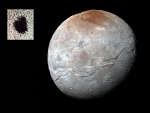 APOD: 2026 June 6 Б Charon: Moon of Pluto
6.06.2026
A darkened and mysterious north polar region known to some as Mordor Macula caps this premier view of Charon, Pluto's largest moon. The high-resolution image was captured by the interplanetary space probe New Horizons near its closest approach to distant Pluto on July 14, 2015.
 Voyager Views Titan s Haze
5.09.2002
Launched in 1977, 25 years ago today, the Voyager 1 spacecraft's historic tour of the outer Solar System took it past Saturn in late 1980. On November 12, 1980, Voyager 1 recorded this view looking across the edge of Titan, Saturn's largest moon, from a distance of about 22,000 kilometers.
 A Sudden Jet on Comet 67P?
18.11.2015
There she blows! A dramatic demonstration of how short-lived some comet jets can be was documented in late July by the robotic Rosetta spacecraft orbiting the nucleus of Comet 67P/Churyumov-Gerasimenko. The featured animation depicts changes in the rotating comet with three illuminating stills.
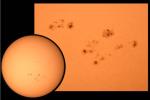 Sunspots and Solar Active Regions
1.08.2002
July was a good month for sunspots ... really big sunspots. In fact, the full disk and inset pictures above show three large groups of spots, photographed only a few days ago on July 28. Together the sunspots span a region about thirty times the diameter of planet Earth.
 Asteroid 2007 TU24 Passes the Earth
30.01.2008
Asteroid 2007 TU24 passed by the Earth yesterday, posing no danger. The space rock, estimated to be about 250 meters across, coasted by just outside the orbit of Earth's Moon. The passing...
 Wonder and Mystery above the Very Large Telescopes
9.05.2011
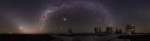
What's that bright orange dot above the large telescope on the right? Even seasoned sky enthusiasts might ponder the origin of the orange orb seen by scrolling across this panoramic image, taken last December. Perhaps identifying known objects will help.
 Stereo Eros
13.02.2021
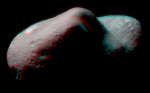
Get out your red/blue glasses and float next to asteroid 433 Eros. Orbiting the Sun once every 1.8 years, the near-Earth asteroid is named for the Greek god of love. Still, its shape more closely resembles a lumpy potato than a heart.
|
January February March April May June July August September |
|||||||||||||||||||||||||||||||||||||||||||||||||