
|
You entered: young stars
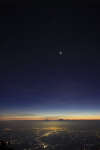 Four Planet Sunset
31.07.2010
This mesmerizing sunset photo was taken from the summit of volcanic Mount Lawu, 3,265 meters above sea level, on July 21. The view looks west, toward the city lights of Surakarta (aka Solo), Central Java, Indonesia. Two other volcanic peaks, sharp Merapi (left) and Merbabu lie along the colorful horizon.
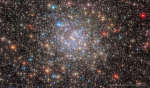 APOD: 2023 January 30 Б Globular Star Cluster NGC 6355 from Hubble
30.01.2023
Globular clusters once ruled the Milky Way. Back in the old days, back when our Galaxy first formed, perhaps thousands of globular clusters roamed our Galaxy. Today, there are less than 200 left. Over the eons, many globular clusters were destroyed by repeated fateful encounters with each other or the Galactic center.
 Zooming in on Star Cluster Terzan 5
24.03.2019
Globular clusters once ruled the Milky Way. Back in the old days, back when our Galaxy first formed, perhaps thousands of globular clusters roamed our Galaxy. Today, there are less than 200 left. Over the eons, many globular clusters were destroyed by repeated fateful encounters with each other or the Galactic center.
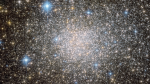 Zooming in on Star Cluster Terzan 5
21.09.2016
Globular clusters once ruled the Milky Way. Back in the old days, back when our Galaxy first formed, perhaps thousands of globular clusters roamed our Galaxy. Today, there are less than 200 left. Over the eons, many globular clusters were destroyed by repeated fateful encounters with each other or the Galactic center.
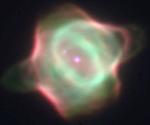 Hen 1357: New Born Nebula
3.04.1998
This Hubble Space Telescope picture shows Hen-1357, the youngest known planetary nebula. Graceful, gentle curves and symmetry suggest its popular name - The Stingray Nebula. Observations in the 1970s detected no nebular material, but this image from March 1996 clearly shows the Stingray's emerging bubbles and rings of shocked and ionized gas.
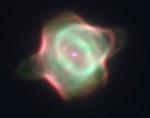 Hen 1357: New Born Nebula
6.10.2001
This Hubble Space Telescope snapshot shows Hen-1357, the youngest known planetary nebula. Graceful, gentle curves and symmetry suggest its popular name - The Stingray Nebula. Observations in the 1970s detected no nebular material, but this image from March 1996 clearly shows the Stingray's emerging bubbles and rings of shocked and ionized gas.
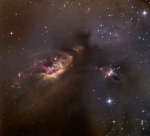 Sh2-239: Celestial Impasto
8.12.2011
The cosmic brush of star formation composed this alluring mix of dust and dark nebulae. Cataloged as Sh2-239 and LDN 1551, the region lies near the southern end of the Taurus molecular cloud complex some 450 light-years distant.
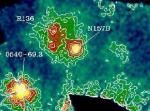 Ultra Fast Pulsar
11.02.1998
Pulsars are rotating neutron stars, born in the violent crucibles of supernova explosions. Like cosmic lighthouses, beams of radiation from surface hotspots sweep past our viewpoint creating pulses which reveal the rotation rates of these incredibly dense stellar corpses. The most famous pulsar of all is found in the nearby supernova remnant, the Crab Nebula.
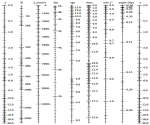 A Redshift Lookup Table for our Universe
8.04.2013
How far away is "redshift six"? Although humans are inherently familiar with distance and time, what is actually measured for astronomical objects is redshift, a color displacement that depends on exactly how energy density has evolved in our universe.
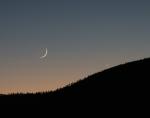 Venus and the 37 Hour Moon
25.12.2003
At Table Mountain Observatory, near Wrightwood California, USA on October 26, wild fires were approaching from the east. But looking toward the west just after sunset, astronomer James Young could still enjoy this comforting view of a young crescent Moon and brilliant Venus through the the fading twilight. Setting over the horizon of Mt.
|
January February March April May June July August |
||||||||||||||||||||||||||||||||||||||||||||||||||||||||