
|
You entered: young stars
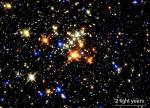 The Quintuplet Star Cluster
21.09.1999
Bright clusters of stars form and disperse near the center of our Galaxy. Four million years ago the Quintuplet Cluster, pictured above, formed and is now slowly dispersing. The Quintuplet Cluster is located within 100 light-years of the Galactic center, and is home to the brightest star yet cataloged in our Galaxy: the Pistol Star.
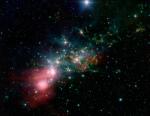 Dusty NGC 1333
24.11.2005
Dusty NGC 1333 is seen as a reflection nebula in visible light images, sporting bluish hues characteristic of starlight reflected by dust. But at longer infrared wavelengths, the interstellar dust itself glows - shown in red in this false-color Spitzer Space Telescope image.
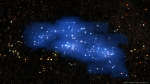 Hyperion: Largest Known Galaxy Proto Supercluster
23.10.2018
How did galaxies form in the early universe? To help find out, astronomers surveyed a patch of dark night sky with the Very Large Telescope array in Chile to find and count galaxies that formed when our universe was very young.
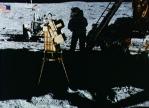 The First Lunar Observatory
11.11.2000
The first, and so far only, lunar astronomical observatory was deployed by the Apollo 16 crew in 1972. The Far Ultraviolet Camera / Spectrograph used a 3-inch diameter Schmidt telescope to photograph the Earth, nebulae, star clusters, and the Large Magellanic Cloud.
 The Wizard Nebula
4.09.2020
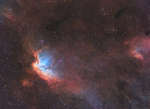
Open star cluster NGC 7380 is still embedded in its natal cloud of interstellar gas and dust popularly known as the Wizard Nebula. Seen on the left, with foreground and background stars along the plane of our Milky Way galaxy it lies some 8,000 light-years distant, toward the constellation Cepheus.
 The Wizard Nebula
29.08.2014
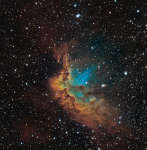
Open star cluster NGC 7380 is still embedded in its natal cloud of interstellar gas and dust popularly known as the Wizard Nebula. Seen with foreground and background stars along the plane of our Milky Way galaxy it lies some 8,000 light-years distant, toward the constellation Cepheus.
 Dusty NGC 1300
6.10.2006
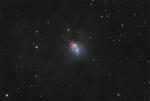
Dusty NGC 1333 is seen in visible light as a reflection nebula, dominated by bluish hues characteristic of starlight reflected by dust. But at longer infrared wavelengths, the interstellar dust itself glows. Moving your...
 Sibling Supernova Remnants
2.07.2026
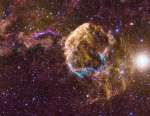
What happens when one of the stars in a binary goes supernova? This image combines visible (yellow), ultraviolet (purple) and infrared light (cyan, red and orange) to show two supernova remnants and their surrounding environment, about 6,000 light-years away. The younger one is the well-known Jellyfish Nebula in the center (mostly in yellow).
 Elements in the Aftermath
1.08.2019
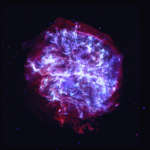
Massive stars spend their brief lives furiously burning nuclear fuel. Through fusion at extreme temperatures and densities surrounding the stellar core, nuclei of light elements ike Hydrogen and Helium are combined to heavier elements like Carbon, Oxygen, etc. in a progression which ends with Iron.
 Twilight with Moon and Planets
21.02.2026
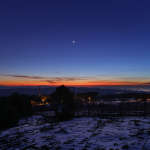
Only two days after the February New Moon's annular eclipse of the Sun, a slender lunar crescent poses above the western horizon after sunset in this wintry twilight skyscape. Its nightside faintly illuminated...
|
January February March April May June July August September |
|||||||||||||||||||||||||||||||||||||||||||||||||