
|
You entered: star cluster
 In the Vicinity of the Cone Nebula
23.11.2008
Strange shapes and textures can be found in neighborhood of the Cone Nebula. The unusual shapes originate from fine interstellar dust reacting in complex ways with the energetic light and hot gas being expelled by the young stars.
 APOD: 2023 May 8 Б The Spanish Dancer Spiral Galaxy
8.05.2023
If not perfect, then this spiral galaxy is at least one of the most photogenic. An island universe containing billions of stars and situated about 40 million light-years away toward the constellation of the Dolphinfish (Dorado), NGC 1566 presents a gorgeous face-on view.
 A Perfect Spiral
13.08.2021
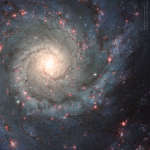
If not perfect then this spiral galaxy is at least one of the most photogenic. An island universe of about 100 billion stars, 32 million light-years away toward the constellation Pisces, M74 presents a gorgeous face-on view.
 Gigagalaxy Zoom: Galactic Center
25.09.2009
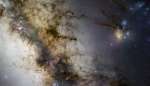
From Sagittarius to Scorpius, the central Milky Way is a truly beautiful part of planet Earth's night sky. The gorgeous region is captured here, an expansive gigapixel mosaic of 52 fields spanning 34 by 20 degrees in 1200 individual images and 200 hours of exposure time.
 December s Comet Wirtanen
7.12.2018
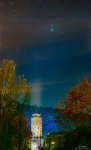
Coming close in mid-December, Comet 46P Wirtanen hangs in this starry sky over the bell tower of a Romanesque church. In the constructed vertical panorama, a series of digital exposures capture its greenish coma on December 3 from Sant Llorenc de la Muga, Girona, Catalonia, Spain, planet Earth.
 M16: Pillars of Star Creation
24.04.2016
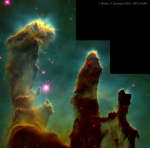
Newborn stars are forming in the Eagle Nebula. This image, taken with the Hubble Space Telescope in 1995, shows evaporating gaseous globules (EGGs) emerging from pillars of molecular hydrogen gas and dust. The giant pillars are light years in length and are so dense that interior gas contracts gravitationally to form stars.
 Bright Jupiter in Taurus
27.11.2012
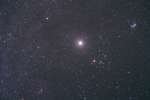
That bright star you've recently noticed rising just after sunset isn't a star at all. It's Jupiter, the solar system's ruling gas giant. Bright Jupiter is nearing its December 3rd opposition when it will stand in Taurus, opposite the Sun in planet Earth's sky.
 Hot Gas Halo Detected Around Galaxy NGC 4631
25.07.2001
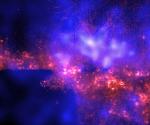
Is our Milky Way Galaxy surrounded by a halo of hot gas? A step toward solving this long-standing mystery was taken recently with Chandra X-ray observations of nearby galaxy NGC 4631. In the above composite picture, newly resolved diffuse X-ray emission is shown in blue, superposed on a HST image showing massive stars in red.
 Spiral Galaxy NGC 1672 from Hubble
13.05.2012
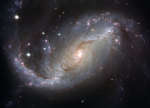
Many spiral galaxies have bars across their centers. Even our own Milky Way Galaxy is thought to have a modest central bar. Prominently barred spiral galaxy NGC 1672, pictured above, was captured in spectacular detail in image taken by the orbiting Hubble Space Telescope.
 Open Cluster NGC 6520 from CFHT
22.07.2002
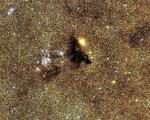
Did you ever have a day when it felt like a dark cloud was following you around? For the open cluster of stars NGC 6520, every day is like this. On the left of the above picture are many of NGC 6520's bright blue stars.
|
January February March April May |
|||||||||||||||||||||||||||||||||||||||||||||||||