
|
You entered: nearest stars
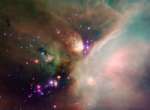 Young Stars in the Rho Ophiuchi Cloud
15.02.2008
Cosmic dust clouds and embedded newborn stars glow at infrared wavelengths in this tantalizing false-color view from the Spitzer Space Telescope. Pictured is of one of the closest star forming regions, part of the Rho Ophiuchi cloud complex some 400 light-years distant near the southern edge of the pronounceable constellation Ophiuchus.
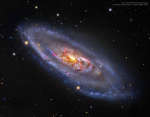 M106: A Spiral Galaxy with a Strange Center
17.03.2019
What's happening at the center of spiral galaxy M106? A swirling disk of stars and gas, M106's appearance is dominated by blue spiral arms and red dust lanes near the nucleus, as shown in the featured image.
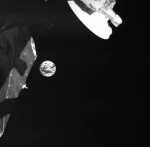 Earth Flyby of BepiColombo
4.05.2020
What it would look like to approach planet Earth? Such an event was recorded visually in great detail by ESA's and JAXA's robotic BepiColombo spacecraft last month as it swung back past Earth on its journey in to the planet Mercury.
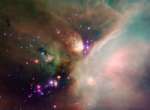 Young Stars in the Rho Ophiuchi Cloud
13.11.2009
Cosmic dust clouds and embedded newborn stars glow at infrared wavelengths in this tantalizing false-color view from the Spitzer Space Telescope. Pictured is of one of the closest star forming regions, part of the Rho Ophiuchi cloud complex some 400 light-years distant near the southern edge of the pronounceable constellation Ophiuchus.
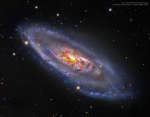 M106: A Spiral Galaxy with a Strange Center
15.02.2015
What's happening at the center of spiral galaxy M106? A swirling disk of stars and gas, M106's appearance is dominated by blue spiral arms and red dust lanes near the nucleus, as shown in the featured image.
 APOD: 2024 October 29 Б NGC 602: Stars Versus Pillars from Webb
29.10.2024
The stars are destroying the pillars. More specifically, some of the newly formed stars in the image center are emitting light so energetic that is evaporating the gas and dust in the surrounding pillars. Simultaneously, the pillars themselves are still trying to form new stars.
 APOD: 2024 December 24 Б Fox Fur, Cone, and Christmas Tree
24.12.2024
What do the following things have in common: a cone, the fur of a fox, and a Christmas tree? Answer: they all occur in the constellation of the Unicorn (Monoceros). Considered as a star...
 Mu Cephei
12.10.2023
Mu Cephei is a very large star. An M-class supergiant some 1500 times the size of the Sun, it is one of the largest stars visible to the unaided eye, and even one of the largest in the entire Galaxy.
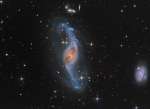 Twisting with NGC 3718
3.08.2013
A careful look at this colorful cosmic snapshot reveals a surprising number of galaxies both near and far toward the constellation Ursa Major. The most striking is NGC 3718, the warped spiral galaxy near picture center. NGC 3718's spiral arms look twisted and extended, mottled with young blue star clusters.
 A Flight Through the Universe
13.08.2012
What would it be like to fly through the universe? Possibly the best simulated video of this yet has been composed from recently-released galaxy data from the Sloan Digital Sky Survey. Every spot in the above video is a galaxy containing billions of stars.
|
January February March April May June July August September October |
|||||||||||||||||||||||||||||||||||||||||||||||||