
|
You entered: dust cloud
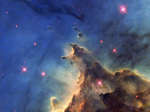 NGC 2174: Stars Versus Mountains
9.02.2011
It's stars versus gas mountains in NGC 2174 and the stars are winning. More precisely, the energetic light and winds from massive newly formed stars are evaporating and dispersing the dark stellar nurseries in which they formed.
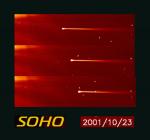 SOHO Comet 367: Sungrazer
9.11.2001
The most prolific comet discovering instrument in history rides aboard the sun-staring SOHO spacecraft, 1.5 million kilometers sunward of planet Earth. Of course, most of these SOHO comets have been sungrazers - like the one illustrated in the dramatic montage above.
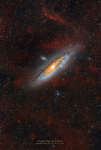 Clouds of Andromeda
4.01.2017
The beautiful Andromeda Galaxy is often imaged by planet Earth-based astronomers. Also known as M31, the nearest large spiral galaxy is a familiar sight with dark dust lanes, bright yellowish core, and spiral arms traced by blue starlight.
 APOD: 2025 May 27 Б Zeta and Rho Ophiuchi with Milky Way
27.05.2025
Behold one of the most photogenic regions of the night sky, captured impressively. Featured, the band of our Milky Way Galaxy runs diagonally along the bottom-left corner, while the colorful Rho Ophiuchi cloud complex is visible just right of center and the large red circular Zeta Ophiuchi Nebula appears near the top.
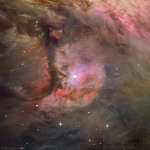 M43: Dust, Gas, and Stars in the Orion Nebula
6.07.2020
Unspeakable beauty and unimaginable bedlam can be found together in the Orion Nebula Arguably the most famous of all astronomy nebulas, the Great Nebula in Orion is an immense interstellar molecular cloud only 1500 light-years away.
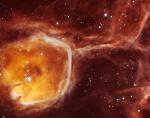 Windblown N44F
19.08.2004
A fast and powerful wind from a hot young star has created this stunning bubble-shaped nebula poised on the end of a bright filament of hydrogen gas. Cataloged as N44F, the cosmic windblown bubble is seen at the left of this Hubble Space Telescope image.
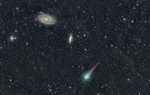 Comet PanSTARRs and the Galaxies
6.06.2020
Comet PanSTARRs, C/2017 T2, shared this stunning telescopic field of view with galaxies M81 and M82 on May 22/23. Of course, the galaxies were some 12 million light-years distant and the comet about 14 light-minutes away, seen in planet Earth's sky toward the Big Dipper.
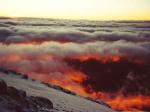 Sunrise Over Kilimanjaro
11.07.2005
Is the Roof of Africa on fire? A group hiking at 6 am near the top of Mt. Kilimanjaro watched the rising sun peak above the clouds and the horizon light up red. Don't worry -- in this case the highest volcano in Africa is not even erupting.
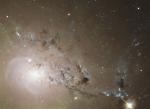 NGC 1275: A Galactic Collision
5.05.2003
In NGC 1275, one galaxy is slicing through another. The disk of the dusty spiral galaxy near the image center is cutting through a large elliptical galaxy, visible predominantly on the lower left. Galaxies...
 APOD: 2023 October 10 Б Hidden Orion from Webb
10.10.2023
The Great Nebula in Orion has hidden stars. To the unaided eye in visible light, it appears as a small fuzzy patch in the constellation of Orion. But this image was taken by the Webb Space Telescope in a representative-color composite of red and very near infrared light.
|
January February March April May June July August September |
|||||||||||||||||||||||||||||||||||||||||||||||||