
|
You entered: red dwarf
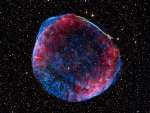 SN 1006 Supernova Remnant
12.07.2014
A new star, likely the brightest supernova in recorded human history, lit up planet Earth's sky in the year 1006 AD. The expanding debris cloud from the stellar explosion, found in the southerly constellation of Lupus, still puts on a cosmic light show across the electromagnetic spectrum.
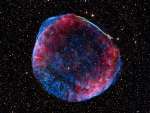 SN 1006 Supernova Remnant
1.08.2009
A new star, likely the brightest supernova in recorded human history, lit up planet Earth's sky in the year 1006 AD. The expanding debris cloud from the stellar explosion, found in the southerly constellation of Lupus, still puts on a cosmic light show across the electromagnetic spectrum.
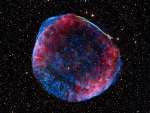 SN 1006 Supernova Remnant
4.07.2008
A new star, likely the brightest supernova in recorded human history, lit up planet Earth's sky in the year 1006 AD. The expanding debris cloud from the stellar explosion, found in the southerly constellation of Lupus, still puts on a cosmic light show across the electromagnetic spectrum.
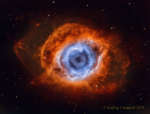 The Helix Nebula in Hydrogen and Oxygen
13.02.2019
Is the Helix Nebula looking at you? No, not in any biological sense, but it does look quite like an eye. The Helix Nebula is so named because it also appears that you are looking down the axis of a helix.
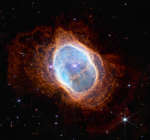 Webb s Southern Ring Nebula
14.07.2022
Cataloged as NGC 3132 the Southern Ring Nebula is a planetary nebula, the death shroud of a dying sun-like star some 2,500 light-years from Earth. Composed of gas and dust the stunning cosmic landscape is nearly half a light-year in diameter, explored in unprecedented detail by the James Webb Space Telescope.
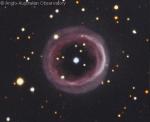 Shapley 1: An Annular Planetary Nebula
25.06.2000
What happens when a star runs out of nuclear fuel? The center condenses into a white dwarf while the outer atmospheric layers are expelled into space and appear as a planetary nebula. This particular planetary nebula, designated Shapley 1 after the famous astronomer Harlow Shapley, has a very apparent annular ring like structure.
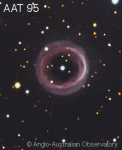 Shapley 1: An Annular Planetary Nebula
15.02.1997
What happens when a star runs out of nuclear fuel? The center condenses into a white dwarf while the outer atmospheric layers are expelled into space and appear as a planetary nebula. This particular planetary nebula, designated Shapley 1 after the famous astronomer Harlow Shapley, has a very apparent annular ring like structure.
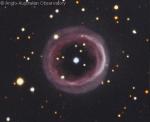 Shapley 1: An Annular Planetary Nebula
9.08.1998
What happens when a star runs out of nuclear fuel? The center condenses into a white dwarf while the outer atmospheric layers are expelled into space and appear as a planetary nebula. This particular planetary nebula, designated Shapley 1 after the famous astronomer Harlow Shapley, has a very apparent annular ring like structure.
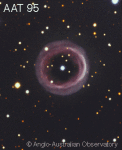 Shapley 1: An Annular Planetary Nebula
12.12.1995
This strange structure is what can result when a normal star runs out of nuclear fuel in its core. At that time, the center condenses into a white dwarf while the outer atmospheric layers are expelled into space and appear as a planetary nebula.
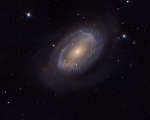 The Easterbunny Comes to NGC 4725
12.08.2016
At first called "Easterbunny" by its discovery team, officially named Makemake is the second brightest dwarf planet of the Kuiper belt. The icy world appears twice in this astronomical image, based on data taken on June 29 and 30 of the bright spiral galaxy NGC 4725.
|
January February March April May June July August September October |
|||||||||||||||||||||||||||||||||||||||||||||||||