
|
You entered: phase
 Cat s Eye Wide and Deep
24.05.2023
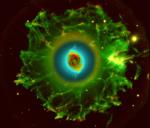
The Cat's Eye Nebula (NGC 6543) is one of the best known planetary nebulae in the sky. Its more familiar outlines are seen in the brighter central region of the nebula in this impressive wide-angle view. But this wide and deep image combining data from two telescopes also reveals its extremely faint outer halo.
 Halo of the Cat's Eye
4.09.2002
The Cat's Eye Nebula (NGC 6543) is one of the best known planetary nebulae in the sky. Its haunting symmetries are seen in the very central region of this stunning false-color picture, processed...
 The Lunar X
9.12.2016
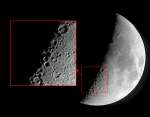
The striking X appearing in this lunarscape is easily visible in binoculars or a small telescope. Yet, not too many have seen it. The catch is this lunar X is fleeting, only apparent in the hours before the Moon's first quarter phase.
 Eclipse Pair
2.01.2025
Eclipses tend to come in pairs. Twice a year, during an eclipse season that lasts about 34 days, Sun, Moon, and Earth can nearly align. Then the full and new phases of the Moon, separated by just over 14 days, create a lunar and a solar eclipse.
 Halo of the Cats Eye
9.05.2010
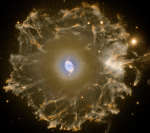
The Cat's Eye Nebula (NGC 6543) is one of the best known planetary nebulae in the sky. Its haunting symmetries are seen in the very central region of this stunning false-color picture, processed...
 Gibbous Europa
29.01.2011
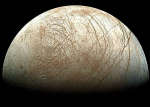
Although the phase of this moon might appear familiar, the moon itself might not. In fact, this gibbous phase shows part of Jupiter's moon Europa. The robot spacecraft Galileo captured this image mosaic during its mission orbiting Jupiter from 1995 - 2003.
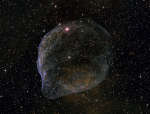 Sharpless 308: Star Bubble
24.12.2013
Blown by fast winds from a hot, massive star, this cosmic bubble is huge. Cataloged as Sharpless 2-308 it lies some 5,200 light-years away toward the constellation of the Big Dog (Canis Major) and covers slightly more of the sky than a Full Moon.
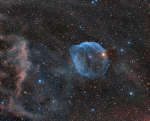 Sharpless 308: Star Bubble
30.01.2019
Blown by fast winds from a hot, massive star, this cosmic bubble is huge. Cataloged as Sharpless 2-308 it lies some 5,200 light-years away toward the constellation of the Big Dog (Canis Major) and covers slightly more of the sky than a Full Moon.
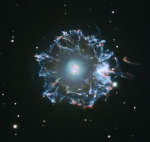 Halo of the Cat s Eye
19.10.2018
Not a Falcon 9 rocket launch after sunset, the Cat's Eye Nebula (NGC 6543) is one of the best known planetary nebulae in the sky. Its haunting symmetries are seen in the very...
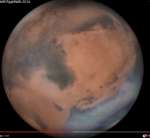 Mars at Closest Approach 2016
8.08.2016
When does Mars appear the largest? This occurs when Earth sweeps past Mars in their respective orbits around the Sun, creating a momentary Sun-Earth-Mars alignment called opposition. The featured video shows the Mars opposition that occurred earlier this year. All of the images were taken from Earth with a small telescope.
|
January February March April May June July August |
||||||||||||||||||||||||||||||||||||||||||||||||||||||||