
|
You entered: morning star
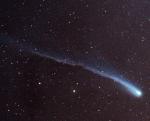 Comet Ikeya Zhang Brightens
6.03.2002
In the last week, Comet Ikeya-Zhang has become bright enough to be just visible to the unaided eye. Based on its present activity, observers are optimistic that Ikeya-Zhang will become substantially brighter. This composite...
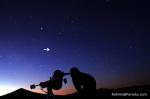 Nova Over Iran
18.02.2007
A bright new nova is being studied by astronomers. The officially dubbed Nova Scorpii 2007 has become so bright in recent days that it is now visible to the unaided eye. Adventurous early morning sky enthusiasts should look in dark skies toward the constellation of the Scorpion, just below Jupiter and Antares.
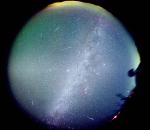 A Sky Filled with Leonids
4.12.2001
In the early morning hours of November 19, amateur Chen Huang-Ming caught a sky filled with astronomical wonders. With his fisheye camera set up on Ho-Huan Mountain in Taiwan for a half-hour exposure, he started the above image a local time of 2:33 am.
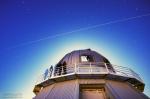 ISS Over Mont Megantic Observatory
18.08.2007
On August 1st, a time exposure created this surreal view that looks up into the early morning sky over southern Quebec. Only the light from a nearly Full Moon brightens the sky and highlights the dome of the 1.6 meter telescope at Mont-Megantic Observatory.
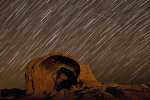 Quadrantids over Qumis
13.01.2011
The Quadrantid Meteor Shower is an annual event for planet Earth's northern hemisphere skygazers. It usually peaks briefly in the cold, early morning hours of January 4. The shower is named for its radiant point on the sky within the old, astronomically obsolete constellation Quadrans Muralis.
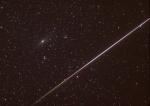 Island Universe, Cosmic Sand
23.08.2002
On August 13, while counting Perseid meteors under dark, early morning Arizona skies, Rick Scott set out to photograph their fleeting but fiery trails. The equipment he used included a telephoto lens and fast color film. After 21 pictures he'd caught only two meteors, but luckily this was one of them.
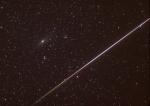 Island Universe, Cosmic Sand
2.08.2003
On August 13, 2002, while counting Perseid meteors under dark, early morning Arizona skies, Rick Scott set out to photograph their fleeting but fiery trails. The equipment he used included a telephoto lens and fast color film. After 21 pictures he'd caught only two meteors, but luckily this was one of them.
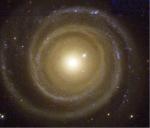 The Spiral Arms of NGC 4622
24.01.2002
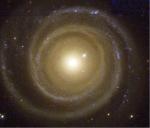
While stirring a morning cup of coffee and thinking cosmic thoughts many astronomers would glance at this Hubble Space Telescope image of spiral galaxy NGC 4622 and assume that the galaxy was rotating counterclockwise in the picture.
 The Spiral Arms of NGC 4622
20.02.2004
While stirring a morning cup of coffee and thinking cosmic thoughts many astronomers would glance at this Hubble Space Telescope image of spiral galaxy NGC 4622 and assume that the galaxy was rotating counterclockwise in the picture.
 Leonid Fireball over Tenerife
22.11.2011
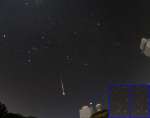
Historically active, this year's Leonid meteor shower was diminished by bright moonlight. Still, faithful night sky watchers did see the shower peak on November 18 and even the glare of moonlight didn't come close to masking this brilliant fireball meteor.
|
January February March April May June July August September October |
|||||||||||||||||||||||||||||||||||||||||||||||||