
|
You entered: massive stars
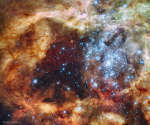 Star Cluster R136 Breaks Out
10.01.2021
In the center of nearby star-forming region lies a huge cluster containing some of the largest, hottest, and most massive stars known. These stars, known collectively as star cluster R136, part of the Tarantula Nebula, were captured in the featured image in visible light in 2009 through the Hubble Space Telescope.
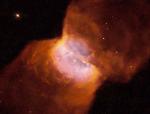 NGC 2346: A Butterfly-Shaped Planetary Nebula
28.10.2001
It may look like a butterfly, but it's bigger than our Solar System. NGC 2346 is a planetary nebula made of gas and dust that has evolved into a familiar shape. At the heart of the bipolar planetary nebula is a pair of close stars orbiting each other once every sixteen days.
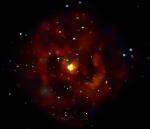 X Rays from M83
6.02.2003
Bright and beautiful spiral galaxy M83 lies a mere twelve million light-years from Earth, toward the headstrong constellation Hydra. Sweeping spiral arms, prominent in visible light images, lend this galaxy its popular moniker -- the Southern Pinwheel.
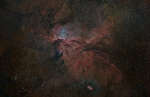 NGC 6188 and NGC 6164
1.02.2014
Fantastic shapes lurk in clouds of glowing gas in NGC 6188, about 4,000 light-years away. The emission nebula is found near the edge of a large molecular cloud unseen at visible wavelengths, in the southern constellation Ara.
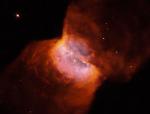 NGC 2346: A Butterfly Shaped Planetary Nebula
12.10.1999
It may look like a butterfly, but it's bigger than our Solar System. NGC 2346 is a planetary nebula made of gas and dust that has evolved into a familiar shape. At the heart of the bipolar planetary nebula is a pair of close stars orbiting each other once every sixteen days.
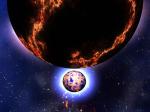 Short Gamma Ray Bursts Localized
17.10.2005
What causes gamma-ray bursts? The most energetic type of explosions known in the cosmos has been an enigma since discovered over 30 years ago. It now appears that there may not be one unique type of progenitor.
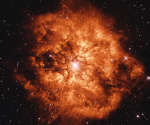 Wolf Rayet Star 124: Stellar Wind Machine
1.07.2014
Some stars explode in slow motion. Rare, massive Wolf-Rayet stars are so tumultuous and hot that they slowly disintegrating right before our telescopes. Glowing gas globs each typically over 30 times more massive than the Earth are being expelled by violent stellar winds.
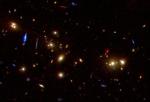 The Lynx Arc
5.11.2003
While chasing the spectrum of a mysterious arc in a cluster of galaxies within the obscure northerly constellation Lynx, astronomers have stumbled upon the most massive and distant star-forming region ever discovered. The notably...
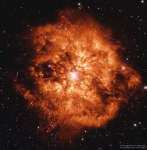 Wolf Rayet Star 124: Stellar Wind Machine
8.03.2020
Some stars explode in slow motion. Rare, massive Wolf-Rayet stars are so tumultuous and hot that they are slowly disintegrating right before our telescopes. Glowing gas globs each typically over 30 times more massive than the Earth are being expelled by violent stellar winds.
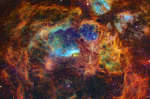 NGC 6357: The Lobster Nebula
28.10.2020
Why is the Lobster Nebula forming some of the most massive stars known? No one is yet sure. Cataloged as NGC 6357, the Lobster Nebula houses the open star cluster Pismis 24 near its center -- a home to unusually bright and massive stars.
|
January February March April May June July August September |
|||||||||||||||||||||||||||||||||||||||||||||||||