
|
You entered: dwarf planet
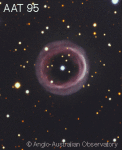 Shapley 1: An Annular Planetary Nebula
12.12.1995
This strange structure is what can result when a normal star runs out of nuclear fuel in its core. At that time, the center condenses into a white dwarf while the outer atmospheric layers are expelled into space and appear as a planetary nebula.
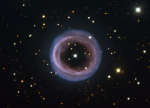 Shapley 1: An Annular Planetary Nebula
16.08.2011
What happens when a star runs out of nuclear fuel? For stars about the mass of our Sun, the center condenses into a white dwarf while the outer atmospheric layers are expelled into space and appear as a planetary nebula.
 NGC 6302: The Butterfly Nebula
6.06.2025
The bright clusters and nebulae of planet Earth's night sky are often given the names of flowers or insects, and its whopping 3 light-year wingspan, NGC 6302 is no exception. With an estimated...
 APOD: 2023 September 20 Б Methane Discovered on Distant Exoplanet
20.09.2023
Where else might life exist? One of humanity's great outstanding questions, locating planets where extrasolar life might survive took a step forward in 2019 with the discovery of a significant amount of water vapor in the atmosphere of distant exoplanet K2-18b.
 Planetary Nebula NGC 2440
15.02.2007
Planetary nebula NGC 2440 has an intriguing bow-tie shape in this stunning view from space. The nebula is composed of material cast off by a dying sun-like star as it enters its white dwarf phase of evolution.
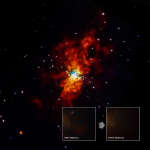 No X rays from SN 2014J
16.08.2014
Last January, telescopes in observatories around planet Earth were eagerly used to watch the rise of SN 2014J, a bright supernova in nearby galaxy M82. Still, the most important observations may have been from orbit where the Chandra X-ray Observatory saw nothing.
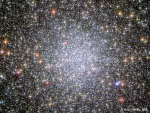 Globular Star Cluster 47 Tuc
19.05.2015
Globular star cluster 47 Tucanae is a jewel box of the southern sky. Also known as NGC 104, it roams the halo of our Milky Way Galaxy along with over 150 other globular star clusters.
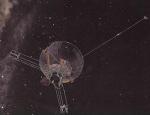 Pioneer 10: The First 6 Billion Miles
3.03.1997
Q: What was made by humans and is 6 billion miles away? A: Pioneer 10 - and yesterday was the 25th anniversary of its launch. More than 9 light hours distant, Pioneer 10 is presently about twice as far from the Sun as Pluto, bound for interstellar space at 28,000 miles per hour.
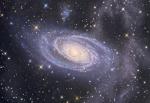 M81 in Ursa Major
27.04.2007
One of the brightest galaxies in planet Earth's sky and similar in size to the Milky Way, big, beautiful spiral M81 lies 11.8 million light-years away in the northern constellation Ursa Major. This...
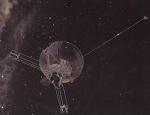 Pioneer 10: The First 6 Billion Miles
20.06.1998
Q: What was made by humans and is 6.5 billion miles away? A: Pioneer 10 - and last year was the 25th anniversary of its launch. More than 9.5 light-hours distant, Pioneer 10 is presently about twice as far from the Sun as Pluto, bound for interstellar space at 28,000 miles per hour.
|
January February March April May June July August |
||||||||||||||||||||||||||||||||||||||||||||||||||||||||