
|
You entered: composite image
 Star Factory Messier 17
29.08.2024
A nearby star factory known as Messier 17 lies some 5,500 light-years away in the nebula-rich constellation Sagittarius. At that distance, this 1.5 degree wide field-of-view would span about 150 light-years.
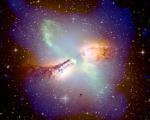 The Colors and Mysteries of Centaurus A
12.08.2002
Why is spiral galaxy Centaurus A in so much turmoil? The above composite image shows different clues to the unusual galaxy's past in different bands of light. In low energy radio waves, shown in red, lobes across the thick swath of dust glow brightly.
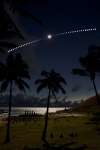 Eclipse on the Beach
30.07.2010
As the New Moon's shadow slid across the southern Pacific on July 11, people gathered along the white, sandy Anakena Beach on the north side of Easter Island to watch a total solar eclipse. The experience was captured in this tantalizing composite image, constructed from a sequence of 50 consecutive exposures.
 APOD: 2024 August 5 Б Milky Way Over Tunisia
5.08.2024
That's no moon. On the ground, that's the Lars Homestead in Tunisia. And that's not just any galaxy. That's the central band of our own Milky Way galaxy. Last, that's not just any meteor. It is a bright fireball likely from last year's Perseids meteor shower.
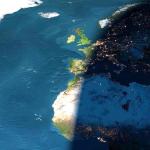 A Digital Sunset Over Europe and Africa
24.03.2003
No single spacecraft or astronaut took this picture. It is a digital composite of archived images taken over many orbits by several Earth-orbiting satellites. Similar images can be digitally stitched together for any Earth location by John Walker's Earth and Moon Viewer website.
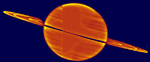 Sunlight Through Saturn's Rings
11.05.1996
Normally, Earth based astronomers view Saturn's spectacular ring system fully illuminated by reflected sunlight. However, this November 1995 Hubble Space Telescope composite image was made to take advantage of an unusual perspective, with the Sun actually illuminating the rings from below.
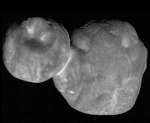 Sharpest Ultima Thule
28.02.2019
On January 1, New Horizons swooped to within 3,500 kilometers of the Kuiper Belt world known as Ultima Thule. That's about 3 times closer than its July 2015 closest approach to Pluto.
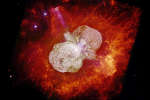 APOD: 2008 June 17- Eta Carinae and the Homunculus Nebula
17.06.2008
How did the star Eta Carinae create this unusual nebula? No one knows for sure. About 165 years ago, the southern star Eta Carinae mysteriously became the second brightest star in the night sky. In 20 years, after ejecting more mass than our Sun, Eta Car unexpected faded.
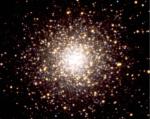 M3: Half A Million Stars
17.09.1999
This immense ball of half a million stars older than the sun lies 30,000 light-years above the plane of our Galaxy. Cataloged as M3 (and NGC 5272), it is one of about 250 globular star clusters which roam our galactic halo.
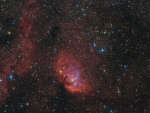 The Tulip in the Swan
21.09.2019
Framing a bright emission region, this telescopic view looks out across a pretty field of stars along the plane of our Milky Way Galaxy, toward the nebula rich constellation Cygnus the Swan. Popularly called...
|
January February March April May June July August September |
|||||||||||||||||||||||||||||||||||||||||||||||||