
|
You entered: colliding galaxies
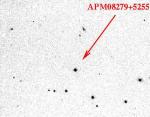 APM 08279+5255: The Brightest Object Yet Known
18.08.1998
It shines with the brightness of 100 billion Suns. Is it a mirage? The recently discovered quasar labeled APM 08279+5255 has set a new record as being the brightest continuously emitting object yet known.
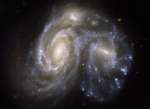 Arp 272
30.04.2008
Linking spiral arms, two large colliding galaxies are featured in this Hubble Space Telescope view, part of a series of cosmic snapshots released to celebrate the Hubble's 18th anniversary. Recorded in astronomer Halton Arp's Atlas of Peculiar Galaxies as Arp 272, the pair is otherwise known as NGC 6050 and IC 1179.
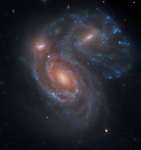 Arp 272
22.09.2011
Linking spiral arms, two large colliding galaxies are featured in this remarkable cosmic portrait constructed using image data from the Hubble Legacy Archive. Recorded in astronomer Halton Arp's Atlas of Peculiar Galaxies as Arp 272, the pair is otherwise known as NGC 6050 near center, and IC 1179 at upper right.
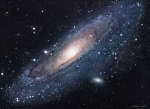 M31: The Andromeda Galaxy
17.12.2018
What is the nearest major galaxy to our own Milky Way Galaxy? Andromeda. In fact, our Galaxy is thought to look much like Andromeda. Together these two galaxies dominate the Local Group of galaxies. The diffuse light from Andromeda is caused by the hundreds of billions of stars that compose it.
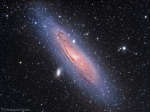 M31: The Andromeda Galaxy
27.12.2016
What is the nearest major galaxy to our own Milky Way Galaxy? Andromeda. In fact, our Galaxy is thought to look much like Andromeda. Together these two galaxies dominate the Local Group of galaxies. The diffuse light from Andromeda is caused by the hundreds of billions of stars that compose it.
 A Quasar Portrait Gallery
25.11.1996
QUASARs (QUASi-stellAR objects) lie near the edge of the observable Universe. Discovered in 1963, astronomers were astounded - to be visible at such extreme distances of billions of light-years they must emit prodigious amounts of energy. Where does the energy come from?
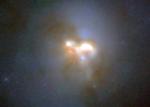 Arp 220: Spirals in Collision
17.06.1997
Arp 220 is the brightest object in the local universe. But why does it shine so brightly? Arp 220 was cataloged as a peculiar galaxy in the 1960s. In the late 1980s, it was discovered to be an ultraluminous infrared galaxy and headed a list compiled from observations with the now-defunct IRAS satellite.
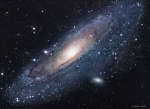 M31: The Andromeda Galaxy
30.08.2015
What is the nearest major galaxy to our own Milky Way Galaxy? Andromeda. In fact, our Galaxy is thought to look much like Andromeda. Together these two galaxies dominate the Local Group of galaxies. The diffuse light from Andromeda is caused by the hundreds of billions of stars that compose it.
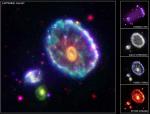 Cartwheel Of Fortune
18.01.2006
By chance, a collision of two galaxies has created a surprisingly recognizable shape on a cosmic scale - The Cartwheel Galaxy. The Cartwheel is part of a group of galaxies about 400 million light years away in the constellation Sculptor (two smaller galaxies in the group are visible below and left).
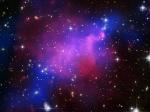 Cluster Crash Illuminates Dark Matter Conundrum
20.08.2007
Huge clusters of galaxies are surely colliding in Abell 520 but astrophysicists aren't sure why the dark matter is becoming separated from the normal matter. The dark matter in the above multi-wavelength image is shown in false blue, determined by carefully detailing how the cluster distorts light emitted by more distant galaxies.
|
January February March April May June July August September |
|||||||||||||||||||||||||||||||||||||||||||||||||