
|
You entered: binary star
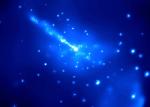 Centaurus A: X Rays from an Active Galaxy
16.08.2001
Its core hidden from optical view by a thick lane of dust, the giant elliptical galaxy Centaurus A was among the first objects observed by the orbiting Chandra X-ray Observatory. Astronomers were not disappointed, as Centaurus A's appearance in x-rays makes its classification as an active galaxy easy to appreciate.
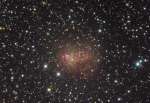 Starburst Galaxy IC 10
9.10.2009
Lurking behind dust and stars near the plane of our Milky Way Galaxy, IC 10 is a mere 2.3 million light-years distant. Its light dimmed by the intervening dust, the irregular dwarf galaxy still shows off vigorous star-forming regions that shine with a telltale reddish glow in this colorful skyscape.
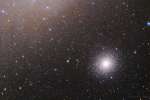 47 Tuc Near the Small Magellanic Cloud
6.12.2012
Globular star cluster 47 Tucanae is a jewel of the southern sky. Also known as NGC 104, it roams the halo of our Milky Way Galaxy along with around 200 other globular star clusters.
 Phi Persei: Double Star
12.12.1997
It's clear who is the biggest star in this binary system. Based on recent results, this artist's vision of the double star Phi Persei, 720 light years away, shows a bright, rapidly rotating massive star surrounded by a disk of gas. A small companion star orbits 100 million miles away.
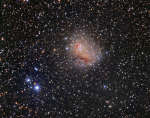 Starburst Galaxy IC 10
4.01.2012
Lurking behind dust and stars near the plane of our Milky Way Galaxy, IC 10 is a mere 2.3 million light-years distant. Even though its light is dimmed by intervening dust, the irregular dwarf galaxy still shows off vigorous star-forming regions that shine with a telltale reddish glow in this colorful skyscape.
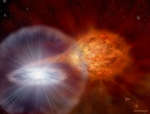 Explosions from White Dwarf Star RS Oph
22.08.2021
Spectacular explosions keep occurring in the binary star system named RS Ophiuchi. Every 20 years or so, the red giant star dumps enough hydrogen gas onto its companion white dwarf star to set off a brilliant thermonuclear explosion on the white dwarf's surface.
 Phi Persei: Double Star
2.10.1999
It's clear who is the biggest star in this binary system. Based on recent results, this artist's vision of the double star Phi Persei, 720 light years away, shows a bright, rapidly rotating massive star surrounded by a disk of gas. A small companion star orbits 100 million miles away.
 BZ Cam Bow Shock
28.11.2000
BZ Cam is a binary star system that is not well understood. In most cataclysmic variables, matter from a normal star accumulates on the surface of the companion white dwarf star, eventually causing a nova-like flare as the material becomes hot enough to ignite nuclear fusion.
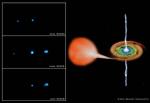 The X Ray Jets of XTE J1550
8.10.2002
The motion of ultra-fast jets shooting out from a candidate black hole star system have now been documented by observations from the orbiting Chandra X-ray Observatory. In 1998, X-ray source XTE J1550-564 underwent a tremendous outburst.
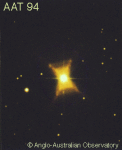 The Red Rectangle
2.11.1995
The unusual geometry of this stellar nebula creates somewhat of a mystery. At the nebula's center is a young binary star system that probably created the nebula, but how? This type of nebula shows a "bipolar flow" which carries a significant amount of mass away from the central stars.
|
January February March April May June July August September |
|||||||||||||||||||||||||||||||||||||||||||||||||