
|
You entered: ancient
 The Antikythera Mechanism
5.12.2006
What is it? It was found at the bottom of the sea aboard an ancient Greek ship. Its seeming complexity has prompted decades of study, although many of its functions remained unknown. Recent X-rays of the device have now confirmed the nature of the Antikythera mechanism, and discovered several surprising functions.
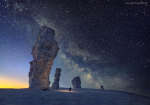 The Milky Way over the Seven Strong Men Rock Formations
3.04.2018
You may have heard of the Seven Sisters in the sky, but have you heard about the Seven Strong Men on the ground? Located just west of the Ural Mountains, the unusual Manpupuner rock formations are one of the Seven Wonders of Russia. How these ancient 40-meter high pillars formed is yet unknown.
 APOD: 2025 August 23 Б Fishing for the Moon
23.08.2025
How big is planet Earth's Moon? Compared to other moons of the Solar System, it's number 5 on the largest to smallest ranked list, following Jupiter's moon Ganymede, Saturn's moon Titan, and Jovian moons Callisto and Io. Continuing the list, the Moon comes before Jupiter's Europa and Neptune's Triton.
 White Rock Fingers on Mars
13.05.2002
What caused this unusual white rock formation on Mars? Intrigued by the possibility that they could be salt deposits left over as an ancient lakebed dried-up, detailed studies of these fingers now indicate a more mundane origin: volcanic ash. Studying the exact color of the formation indicated the volcanic origin.
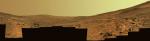 McCool Hill on Mars
15.03.2006
You can make it. Winter is rapidly advancing on the southern hemisphere on Mars, and the lack of sunlight could be dangerous unless you find a good place to hibernate. There it is ahead: McCool Hill.
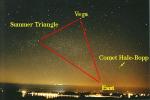 Vega
Vega
15.07.1997
Vega is a bright blue star 25 light years away. Vega is the brightest star in the Summer Triangle, a group of stars easily visible summer evenings in the northern hemisphere. The name Vega...
 Annular Eclipse Over Myanmar
26.01.2010
A hole crossed the Sun for a few minutes this month, as seen across a thin swath of planet Earth. The event on January 15 was actually an annular solar eclipse, and the hole was really Earth's Moon, an object whose dark half may appear even darker when compared to the tremendously bright Sun.
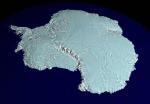 A RADARSAT Map of Antarctica
16.11.1999
It's not easy to make a map of Antarctica. Earth's southern most continent is so cold and inhospitable that much of it remains unexplored. From space, though, it is possible to map this entire region by radar: by systematically noting how long it takes for radio waves to reflect off the terrain.
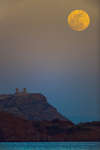 Perigee s Full Moon
22.06.2013
A big, bright, beautiful Full Moon will rise at sunset on Sunday. Its exact full phase (June 23, 11:32 UT) will occur shortly before it reaches perigee, the closest point to Earth in the Moon's orbit, and make it the largest Full Moon of 2013. But such circumstances are not very rare.
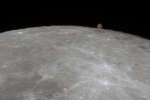 Mars Rises above the Lunar Limb
9.12.2022
On the night of December 7 Mars wandered near the Full Moon. In fact the Red Planet was occulted, passing behind the Moon, when viewed from locations across Europe and North America. About...
|
January February March April May June July August September |
|||||||||||||||||||||||||||||||||||||||||||||||||