
|
You entered: O star
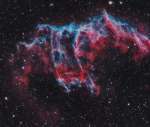 A Spectre in the Eastern Veil
30.10.2013
Frightening forms and scary faces are a mark of the Halloween season. They also haunt this cosmic close-up of the eastern Veil Nebula. The Veil Nebula itself is a large supernova remnant, the expanding debris cloud from the death explosion of a massive star.
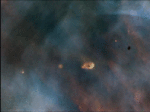 Proplyds: Infant Solar Systems?
17.10.1996
Are planets common in our galaxy? Strong evidence that the answer is "yes" was provided in this 1994 image made by the Hubble Space Telescope . A close-up of the Orion Nebulae, it reveals what seem to be disks of dust and gas surrounding newly formed stars.
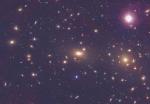 The Coma Cluster of Galaxies
28.03.1999
Almost every object in the above photograph is a galaxy. The Coma Cluster of Galaxies pictured is one of the densest clusters known - it contains thousands of galaxies. Each of these galaxies house billions of stars - just as our own Milky Way Galaxy does.
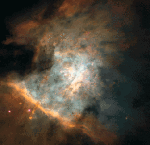 M42: Orion Nebula Mosaic
21.11.1995
The Great Nebula in Orion is one of the most interesting of all astronomical nebulae known. Here fifteen pictures from the Hubble Space Telescope have been merged to show the great expanse and diverse nature of the nebula.
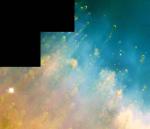 At the Edge of the Helix Nebula
12.05.2002
While exploring the inner edge of the Helix Nebula with the Hubble Space Telescope's Wide Field Planetary Camera 2, astronomers were able to produce this striking image - rich in details of an exotic environment.
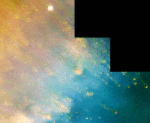 At the Edge of the Helix
22.04.1996
While exploring the inner edge of the Helix Nebula with the Hubble Space Telescope's Wide Field Planetary Camera 2, astronomers were able to produce this striking image - rich in details of an exotic environment.
 At the Edge of the Helix
20.07.1997
While exploring the inner edge of the Helix Nebula with the Hubble Space Telescope's Wide Field Planetary Camera 2, astronomers were able to produce this striking image - rich in details of an exotic environment.
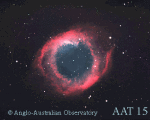 NGC 7293: The Helix Nebula
17.04.1996
The Helix nebula (New General Catalog number 7293) is estimated to be a mere 450 light-years from the Sun, in the direction of the constellation Aquarius. At that distance it may well be the closest planetary nebula, offering a dramatic snapshot of a brief final evolutionary stage in the life of a solar-type star.
 APOD: 2025 April 7 Б NGC 4414: A Flocculent Spiral Galaxy
7.04.2025
How much mass do flocculent spirals hide? The featured image of flocculent spiral galaxy NGC 4414 was taken with the Hubble Space Telescope to help answer this question. Flocculent spirals -- galaxies without well-defined spiral arms -- are a quite common form of galaxy, and NGC 4414 is one of the closest.
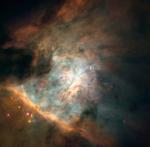 M42: A Mosaic of Orion's Great Nebula
22.05.1999
The Great Nebula in Orion, an immense, nearby starbirth region, is probably the most famous of all astronomical nebulae. Here, 15 pictures from the Hubble Space Telescope have been mosaicked to cover the inner 2.5 light years of the nebula and illustrate its diverse nature.
|
January February March April May June July August September October |
|||||||||||||||||||||||||||||||||||||||||||||||||