
|
You entered: Large Magellanic Cloud
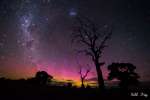 Sky Lights in the New Year
2.01.2016
Triggered by the impact of a coronal mass ejection on New Year's eve, a moderate geomagnetic storm brought a celebration of sky lights to planet Earth's high latitudes yesterday. In this New Year's nightscape, the shimmering reddish curtains of aurora australis along a southern horizon are captured over Morgiana, SW Victoria, Australia.
 ELT and the Milky Way
16.03.2024
The southern winter Milky Way sprawls across this night skyscape. Looking due south, the webcam view was recorded near local midnight on March 11 in dry, dark skies over the central Chilean Atacama desert.
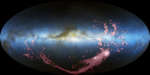 The Magellanic Stream
25.01.2010
Spanning the sky toward the majestic Clouds of Magellan is an unusual stream of gas: the Magellanic Stream. The origin of this gas remains unknown but likely hold a clue to origin and fate of our Milky Way's most famous satellite galaxies: the LMC and the SMC.
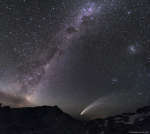 Three Galaxies and a Comet
14.01.2018
Diffuse starlight and dark nebulae along the southern Milky Way arc over the horizon and sprawl diagonally through this gorgeous nightscape. The breath-taking mosaic spans a wide 100 degrees, with the rugged terrain of the Patagonia, Argentina region in the foreground.
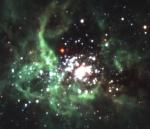 Tarantula
4.06.1997
NGC 2070 is an immense star forming region in a nearby galaxy known as the Large Magellanic Cloud. Its spidery appearance is responsible for its popular name, "The Tarantula Nebula", except that this tarantula is about 1,000 light-years across, and 165,000 light-years away in the southern constellation Dorado.
 Atacama s Cloudy Night
27.07.2013
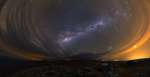
Storm clouds do sometimes come to Chile's Atacama desert, known as the driest place on Earth. These washed through the night sky just last month during the winter season, captured in this panoramic view.
 A Magellanic Starfield
4.01.2003
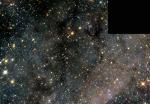
Stars of many types and colors are visible in this Hubble Space Telescope close-up of a starfield in the Large Magellanic Cloud (LMC). Over 10,000 stars are visible -- the brightest of which are giant stars. Were our Sun at the distance of these stars, about 170,000 light-years, it would hardly be discernable.
 The Closest Galaxy: The Sagittarius Dwarf
4.02.1996
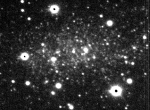
What's the closest galaxy to our Milky Way? For many years astronomers thought it was the Large Magellanic Cloud (LMC). But the seemingly insignificant fuzzy patch shown above turned out to be part of a galaxy that is even closer.
 The Closest Galaxy: The Sagittarius Dwarf
29.03.1997
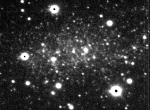
What's the closest galaxy to our Milky Way? For many years astronomers thought it was the Large Magellanic Cloud (LMC). But the seemingly insignificant fuzzy patch shown above turned out to be part of a galaxy that is even closer.
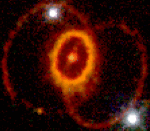 The Mysterious Rings of Supernova 1987a
5.07.1996
What's causing those odd rings in supernova 1987a? In 1987, the brightest supernova in recent history occurred in the Large Magellanic Clouds. At the center of the picture is an object central to the remains of the violent stellar explosion.
|
January February March April May June July August September |
|||||||||||||||||||||||||||||||||||||||||||||||||