
|
You entered: Cygnus
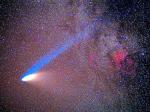 Comet Hale Bopp and the North America Nebula
3.10.2004
Comet Hale-Bopp's 1997 encounter with the inner Solar System allowed many breath-taking pictures. Above, Comet Hale-Bopp was photographed crossing the constellation of Cygnus, sporting spectacular yellow dust and blue ion tails. Visible on the right in red is the North America Nebula, a bright emission nebula observable from a dark location with binoculars.
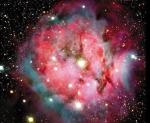 IC 5146: The Cocoon Nebula
14.10.2002
How did this nebula get created? The Cocoon Nebula, cataloged as IC 5146, is a strikingly beautiful nebula located about 4,000 light years away toward the constellation of Cygnus. Inside the Cocoon is a newly developing open cluster of stars.
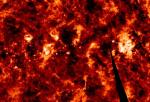 The Frothy Milky Way
2.05.1998
Astronomers have discovered that looking at dust along the plane of our Milky Way Galaxy is a bit like looking into a frothy glass of beer. The dust between stars in our galaxy appears...
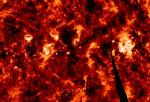 The Frothy Milky Way
9.10.1999
Astronomers have discovered that looking at dust along the plane of our Milky Way Galaxy is a bit like looking into a frothy glass of beer. The dust between stars in our galaxy appears...
 The Frothy Milky Way
24.04.1997
Astronomers have recently discovered that looking at dust along the plane of our Milky Way Galaxy is a bit like looking into a frothy glass of beer. The dust between stars in our galaxy...
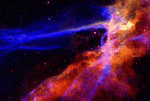 Rampaging Fronts of the Veil Nebula
7.03.1996
A supernova explosion of a high-mass star results in fast moving blast waves. At the front of the waves shown above, ionized gas in the Veil Supernova Remnant rushes out from the explosion, sweeps up material, and breaks up many atoms into constituent ions and electrons.
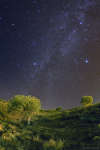 Summer Night in Astronomy Town
12.09.2009
This serene view records a late summer night sky over the rolling, green hills of planet Earth. It was taken near the rural village of Saadat Shahr, Fars province, in southern Iran. Saadat Shahr is also known as Astronomy Town, as the inhabitants have demonstrated a remarakble passion for sky gazing.
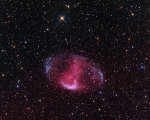 Methuselah Nebula MWP1
21.10.2010
The lovely, symmetric planetary nebula cataloged as MWP1 lies some 4,500 light-years away in the northern constellation Cygnus the Swan. One of the largest planetary nebulae known, it spans about 15 light-years. Based...
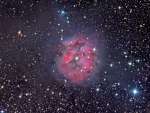 IC 5146: The Cocoon Nebula
5.03.2009
Inside the Cocoon Nebula is a newly developing cluster of stars. Cataloged as IC 5146, the beautiful nebula is nearly 15 light-years wide, located some 4,000 light years away toward the northern constellation Cygnus.
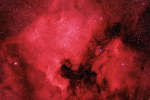 The North America and Pelican Nebulae
30.06.2009
Here are some familiar shapes in unfamiliar locations. This emission nebula on the left is famous partly because it resembles Earth's continent of North America. To the right of the North America Nebula, cataloged as NGC 7000, is a less luminous nebula that resembles a pelican dubbed the Pelican Nebula.
|
January February March April May June July August September |
|||||||||||||||||||||||||||||||||||||||||||||||||