
|
You entered: Barnard
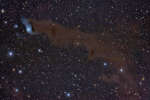 In Wolf s Cave
19.11.2011
The mysterious blue reflection nebula found in catalogs as VdB 152 or Ced 201 really is very faint. It lies at the tip of the long dark nebula Barnard 175 in a dusty complex that has also been called Wolf's Cave.
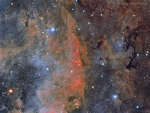 Colorful Star Clouds in Cygnus
21.04.2015
Stars can form in colorful surroundings. Featured here is a star forming region rich in glowing gas and dark dust toward the constellation of the Swan (Cygnus), near the bright star Sadr. This region, which spans about 50 light years, is part of the Gamma Cygni nebula which lies about 1,800 light years distant.
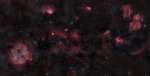 Cepheus: Trunk to Bubble
9.09.2010
Star clusters, glowing nebulae and dark dust clouds abound in Cepheus, royal constellation of the northern hemisphere. You can follow them in amazing detail across this broad skyscape, a mosaic of telescopic images spanning about 17 degrees. Beginning at the lower left, the large emission nebula is cataloged as IC 1396.
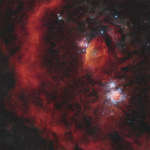 APOD: 2026 February 18 Б Orions Cradle
17.02.2026
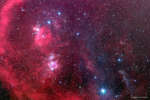
Cradled in red-glowing hydrogen gas, stars are being born in Orion. These stellar nurseries lie at the edge of the giant Orion molecular cloud complex, some 1,500 light-years away. This detailed view spans...
 Southern Orion: From Belt to Witch
8.04.2008
Do you recognize the belt of Orion in this image? The familiar trio of stars, visible to the unaided eye, can be found across the upper left. Otherwise, the southern part of the constellation...
 Orion: Belt, Flame, and Horsehead
3.06.2017
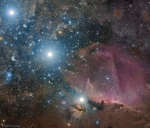
What surrounds the famous belt stars of Orion? A deep exposure shows everything from dark nebula to star clusters, all embedded in an extended patch of gaseous wisps in the greater Orion Molecular Cloud Complex.
 The Big Picture
11.04.2009
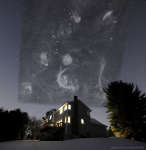
Intricate, glowing nebulae that shine in planet Earth's night sky are beautiful to look at in deep images made with telescopes and sensitive cameras. But they are faint and otherwise invisible to the naked-eye. That makes their relative location and extent on the sky difficult to appreciate.
 LDN 1622: Dark Nebula in Orion
20.02.2020
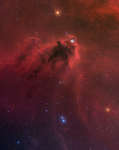
The silhouette of an intriguing dark nebula inhabits this cosmic scene. Lynds' Dark Nebula (LDN) 1622 appears against a faint background of glowing hydrogen gas only visible in long telescopic exposures of the region. In contrast, the brighter reflection nebula vdB 62 is more easily seen, just above and right of center.
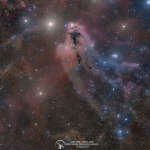 LDN 1622: Dark Nebula in Orion
21.01.2026
The silhouette of an intriguing dark nebula inhabits this cosmic scene. Lynds' Dark Nebula (LDN) 1622 appears against a faint background of glowing hydrogen gas only visible in long telescopic exposures of the region. In contrast, a brighter reflection nebula, vdB 62, is more easily seen just above the dusty dark nebula.
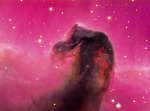 The Horsehead Nebula
26.12.2017
One of the most identifiable nebulae in the sky, the Horsehead Nebula in Orion, is part of a large, dark, molecular cloud. Also known as Barnard 33, the unusual shape was first discovered on a photographic plate in the late 1800s.
|
January February March April May June July August |
||||||||||||||||||||||||||||||||||||||||||||||||||||||||