
|
You entered: space
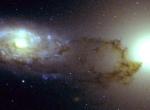 Dusting Spiral Galaxies
16.01.1998
How much dust is in spiral galaxies? Does it block out much of the starlight? Because astronomers rely on an accurate knowledge of galaxy properties to investigate a wide range of problems, like galaxy and quasar evolution and the nature of dark matter, answers to simple questions like this are key.
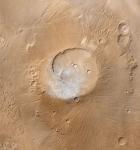 Mars Volcano Apollinaris Patera
13.05.1999
Dwarfed by Olympus Mons and the other immense shield volcanos on Mars, Apollinaris Patera rises only 3 miles or so into the thin martian atmosphere, but bright water-ice clouds can be still be seen hovering around its summit.
 APOD: 2025 August 30 Б A Two Percent Moon
30.08.2025
A young crescent moon can be hard to see. That's because when the Moon shows it's crescent phase (young or old) it can never be far from the Sun in planet Earth's sky.
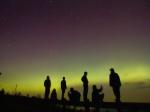 Contemplating the Sky
13.08.2002
Have you contemplated your sky recently? Last night was a good one for midnight meditators at many northerly locations as meteors from the Perseid meteor shower frequently streaked through. The Perseid meteor shower has slowly been building to a crescendo but should continue to be rewarding tonight and into the week.
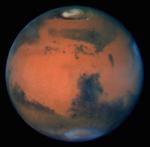 The Weather on Mars
24.03.1997
Would Mars be a nice place to visit? Sometimes. Much of Mars undergoes severe changes in climate during its orbit around the Sun, ranging from extreme cold to temperatures enjoyable by humans. But Mars...
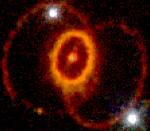 The Mysterious Rings of Supernova 1987a
5.07.1996
What's causing those odd rings in supernova 1987a? In 1987, the brightest supernova in recent history occurred in the Large Magellanic Clouds. At the center of the picture is an object central to the remains of the violent stellar explosion.
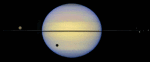 Saturns Rings Seen Sideways
18.10.1998
Saturn's rings are actually very thin. This picture from the Hubble Space Telescope was taken on August 6, 1995 when the rings lined up sideways as seen from Earth. Saturn's largest moon Titan is seen on the left, and Titan's shadow can be seen on Saturn's cloud tops!
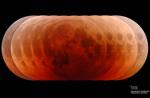 Pumpkin Moon
30.10.2004
Does this look familiar? Red and orange hues haunting the face of the Moon might remind you of the October 27th total lunar eclipse, but the picture is actually a montage of images from a similar lunar spectacle in May of 2003.
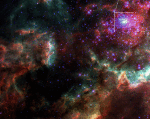 In the Center of 30 Doradus
21.02.1999
In the center of 30 Doradus lies a huge cluster of the largest, hottest, most massive stars known. The center of this cluster, known as R136, is boxed in the upper right portion of the above picture.
 A Flock of Stars
6.09.2008
Only a few stars can be found within ten light-years of our lonely Sun, situated near an outer spiral arm of the Milky Way galaxy. But if the Sun were found within one of our galaxy's star clusters, thousands of stars might occupy a similar space.
|
January February March April May June July August September |
|||||||||||||||||||||||||||||||||||||||||||||||||