
|
You entered: galaxy center
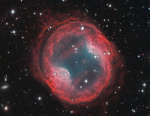 Planetary Nebula PK 164 31
30.10.2012
Is this what will become of our Sun? Quite possibly. The bubble of expanding gas pictured above is the planetary nebula PK 164 +31.1, the remnants of the atmosphere of a Sun-like star expelled as its supply of fusion-able core hydrogen became depleted.
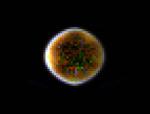 Gamma Ray Earth
3.06.2006
The pixelated planet above is actually our own planet Earth seen in gamma rays - the most energetic form of light. In fact, the gamma rays used to construct this view pack over 35 million electron volts (MeV) compared to a mere two electron volts (eV) for a typical visible light photon.
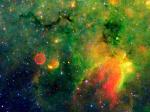 A Galactic Star Forming Region in Infrared
24.09.2007
How do stars form? To help study this complex issue, astronomers took a deep image in infrared light of an active part of our Milky Way Galaxy where star formation is rampant. In IRDC G11.11-0
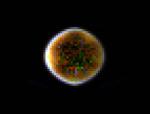 Gamma Ray Earth
31.03.2005
The pixelated planet above is actually our own planet Earth seen in gamma rays - the most energetic form of light. In fact, the gamma rays used to construct this view pack over 35 million electron volts (MeV) compared to a mere two electron volts (eV) for a typical visible light photon.
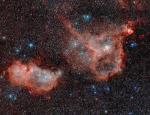 The Heart and Soul Nebulas
22.10.2003
Is heart and soul of our Galaxy located in Cassiopeia? Possibly not, but that is where two bright emission nebulas nicknamed Heart and Soul can be found. The Heart Nebula, officially dubbed IC 1805 and visible above on the right, has a shape reminiscent of a classical heart symbol.
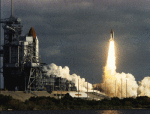 Columbia Waits, Discovery Launches
8.08.1995
Space Shuttle Discovery launches while the Space Shuttle Columbia is readied for a future mission. Space shuttles are launched from the Kennedy Space Center in Florida. At this date there are four operating space shuttles: Atlantis, Columbia, Discovery, and Endeavour. This mission is most famous for carrying the Hubble Space Telescope into orbit.
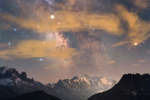 Mont Blanc, Meteor, and Milky Way
15.09.2018
Snowy Mont Blanc is near the center of this atmospheric night skyscape. But high, thin clouds fogged the skies at the photographer's location, looking south toward Europe's highest peak from the southern Swiss Alps.
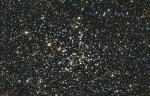 Open Star Cluster M38
7.01.2003
Open cluster M38 can be seen with binoculars toward the constellation of Auriga. M38 is considered an intermediately rich open cluster of stars, each of which is about 200 million years old. Located...
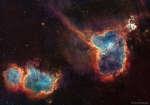 The Heart and Soul Nebulas
16.11.2016
Is the heart and soul of our Galaxy located in Cassiopeia? Possibly not, but that is where two bright emission nebulas nicknamed Heart and Soul can be found. The Heart Nebula, officially dubbed IC 1805 and visible in the featured image on the right, has a shape reminiscent of a classical heart symbol.
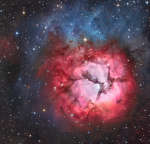 A Beautiful Trifid
12.08.2021
The beautiful Trifid Nebula is a cosmic study in contrasts. Also known as M20, it lies about 5,000 light-years away toward the nebula rich constellation Sagittarius. A star forming region in the plane...
|
January February March April May June July August |
||||||||||||||||||||||||||||||||||||||||||||||||||||||||