
|
You entered: dust
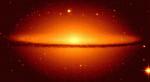 M104: The Sombrero Galaxy
8.02.1997
The famous Sombrero galaxy (M104) is a bright nearby spiral galaxy. The prominent dust lane and halo of stars and globular clusters give this galaxy its name. Something very energetic is going on in the Sombrero's center, as much X-ray light has been detected from it.
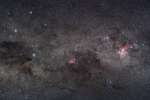 The Southern Cross in a Southern Sky
7.07.2008
This breathtaking patch of sky would be above you were you to stand at the South Pole of the Earth. On the upper left of this image are the four stars that mark the boundaries of the famous Southern Cross.
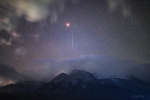 Mars and Meteor over Jade Dragon Snow Mountain
21.11.2020
A brilliant yellowish celestial beacon, Mars still dazzles in the night. Peering between clouds the wandering planet was briefly joined by the flash of a meteor in this moonless dark sky on November 18. The single exposure was taken as the Earth swept up dust from periodic comet Tempel-Tuttle during the annual Leonid Meteor Shower.
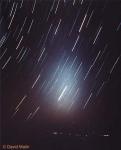 Zodiacal Light
26.08.1997
Sometimes the sky itself seems to glow. Usually, this means you are seeing a cloud reflecting sunlight or moonlight. If the glow appears as a faint band of light running across the whole sky, you are probably seeing the combined light from the billions of stars that compose our Milky Way Galaxy.
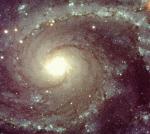 NGC 2997 from VLT
10.03.1999
Add another 8-meter telescope to the list of modern optical telescope giants. Kueyen achieved a first-light photograph of a bright star on March 1, ahead of schedule. The above picture of spiral galaxy...
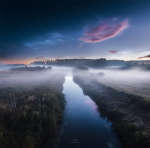 A Northern Summer s Night
7.07.2018
Near a summer's midnight a mist haunts the river bank in this dreamlike skyscape taken on July 3rd from northern Denmark. Reddened light from the Sun a little below the horizon gives an eerie tint to low hanging clouds.
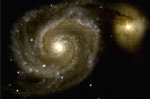 M51: The Whirlpool Galaxy
18.12.1995
The Whirlpool Galaxy is frequently given as an example of a galaxy with classic spiral design. At only 15 million light years distant, M51, also cataloged as NGC 5194, is also one of the brighter and more picturesque galaxies on the sky.
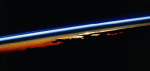 The Sun Also Rises
24.10.1998
Sunrise seen from low Earth orbit by the shuttle astronauts can be very dramatic indeed ( and the authors apologize to Hemingway for using his title!). In this breathtaking view, the Sun is just visible...
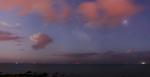 Constellations and Cloudy Skies
11.07.2007
Recorded earlier in July, the clouds of planet Earth reflect moonlight and a faint, reddish glow in this serene sea and skyscape. Beyond them lie the cosmic dust and star clouds of the Milky Way.
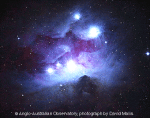 NGC 1977: Blue Reflection Nebula in Orion
1.02.1998
The Orion Nebula is visible to the unaided eye as a fuzzy patch near the famous belt of three stars in the constellation Orion. The above picture captures a part of the Orion Nebula that primarily reflects light from bright Orion stars.
|
January February March April May |
|||||||||||||||||||||||||||||||||||||||||||||||||