
|
You entered: galaxy center
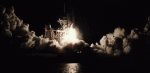 Night Launch of Endeavour
7.08.1995
Space Shuttle Endeavour thunders off into orbit in a rare night launch. This March 1995 mission is most famous for operating the set of astronomical telescopes known as Astro-2. Astro-2's telescopes observed the universe in ultraviolet light - light so blue humans by themselves can't see it.
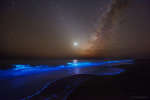 Night Glows
18.04.2017
What glows in the night? This night, several unusual glows were evident -- some near, but some far. The foreground surf glimmers blue with the light of bioluminescent plankton. Next out, Earth's atmosphere dims the horizon and provides a few opaque clouds. Further out, the planet Venus glows bright near the image center.
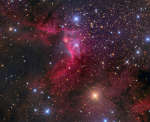 Sh2 155: The Cave Nebula
19.10.2013
This colorful skyscape features the dusty, reddish glow of Sharpless catalog emission region Sh2-155, the Cave Nebula. About 2,400 light-years away, the scene lies along the plane of our Milky Way Galaxy toward the royal northern constellation of Cepheus.
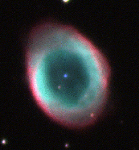 M57: The Ring Nebula
27.07.1995
A star with mass similar to that of our Sun will throw off its outer gasses after fusion has stopped in its core. Possibly the most visually spectacular of these planetary nebula is the pictured Ring Nebula. The appearance as a ring is really an illusion of projection - the nebula is actually a spherical shell.
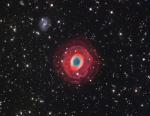 Ringed Nebulae
23.07.2005
This gorgeous celestial vista is centered on one of the Milky Way's own planetary nebulae, M57, the famous Ring Nebula. The wide view is a composite of three exposures; one to record...
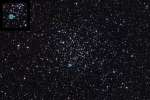 Stars Young and Old
26.03.2009
Galactic or open star clusters are relatively young. These swarms of stars are born near the plane of the Milky Way, but their numbers steadily dwindle as cluster members are strewn through the Galaxy by gravitational interactions.
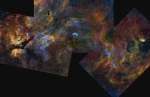 Cygnus Trio
7.11.2008
In this colorful mosaic, filaments of gas and dust span some 9 degrees across central Cygnus, a nebula rich constellation along the northern Milky Way. A trio of nebulae with popular names highlights the beautiful skyscape - the Butterfly, the Crescent, and the Tulip.
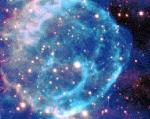 A Wolf-Rayet Star Blows Bubbles
3.01.1997
Wolf-Rayet stars can blow bubbles. These unusual stars are much hotter and more luminous than our Sun. All extremely massive stars will eventually evolve though a Wolf-Rayet phase. Approximately 200 Wolf-Rayet stars are known in our Milky Way Galaxy. Wolf-Rayet stars generate bubbles because they continually eject their outer atmosphere as a stellar wind.
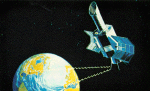 The International Ultraviolet Explorer
29.09.1995
The International Ultraviolet Explorer (IUE) was launched by a NASA Delta rocket in 1978 to provide a space telescope for ultraviolet astronomy. A collaborative project among NASA, ESA and the British SRC (now PPARC) agencies, IUE's estimated lifetime was 3 to 5 years.
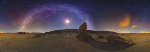 The Milky Way Over Tenerife
5.04.2011
Have you ever seen the band of our Milky Way Galaxy? Chances are you have never seen it like this -- nor could you. In a clear sky from a dark location at the right time, a faint band of light is visible across the sky. This band is the disk of our spiral galaxy.
|
January February March April May June July August |
||||||||||||||||||||||||||||||||||||||||||||||||||||||||