
|
You entered: Solar System
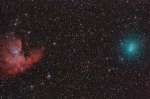 Pacman and Hartley
7.10.2010
Touring the solar system with a 6 year orbital period, small comet Hartley 2 (103/P Hartley) will make its closest approach to planet Earth on October 20 and its closest approach to the Sun on October 28. It may become a naked-eye comet, just visible in clear, dark skies.
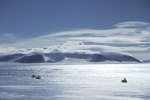 APOD: 2011 December 11 Searching for Meteorites in Antarctica
11.12.2011
Where is the best place on Earth to find meteorites? Although meteors fall all over the world, they usually just sink to the bottom of an ocean, are buried by shifting terrain, or are easily confused with terrestrial rocks.
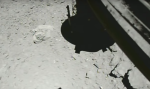 Hayabusa2 Ascends from Asteroid Ryugu
31.10.2018
Will spacecraft Hayabusa2 be able to land safely on asteroid Ryugu? Since arriving in June, pictures show that the surface of kilometer-sized Ryugu is covered with boulders, so that finding a flat enough area for the bus-sized spacecraft to touch down is proving a challenge.
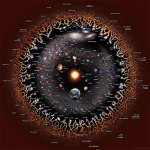 The Observable Universe
15.03.2022
How far can you see? Everything you can see, and everything you could possibly see, right now, assuming your eyes could detect all types of radiations around you -- is the observable universe. In light...
 The First Image of an Extra Solar Planet
10.05.2005
It's the faint red object, not the bright white one that might be a historic find. The white object is surely a brown dwarf star. Quite possibly, however, the red object is the first direct image of a planet beyond our Solar System.
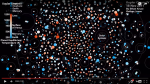 Kepler Orrery IV
4.12.2015
The exoplanet hunting Kepler mission's total for candidate and confirmed multiple planet systems stands at 1,705 worlds in orbit around 685 distant stars. Put all of those exoplanet orbits on the same scale and follow their relative orbital motions to get Kepler Orrery IV.
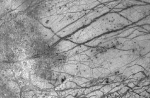 Galileo Explores Europa
14.08.1996
Details of the crazed cracks criss-crossing Europa's frozen surface are apparent in this mosaic of the Galileo spacecraft's latest images of Jupiter's ice-covered moon. Curious white stripes, also seen by Voyager, are clearly visible marking the center of the wide dark fractures.
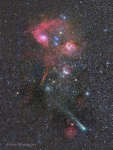 Comet, Clusters, and Nebulae
12.09.2018
Bright enough for binocular viewing Comet 21P / Giacobini-Zinner stands out, even in this deep telephoto mosaic of the star cluster and nebula rich constellation Auriga the Charioteer. On the night of September...
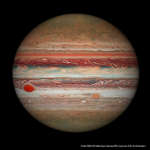 Hubbles Jupiter and the Shrinking Great Red Spot
24.04.2018
What will become of Jupiter's Great Red Spot? Gas giant Jupiter is the solar system's largest world with about 320 times the mass of planet Earth. Jupiter is home to one of the largest and longest lasting storm systems known, the Great Red Spot (GRS), visible to the left.
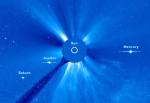 Planets In The Sun
5.05.2000
Today, all five naked-eye planets (Mercury, Venus, Mars, Jupiter, Saturn) plus the Moon and the Sun will at least approximately line-up. As viewed from planet Earth, they will be clustered within about 26 degrees, the closest alignment for all these celestial bodies since February 1962, when there was a solar eclipse!
|
January February March April May June July August September October November |
||||||||||||||||||||||||||||||||||||||||||||||||||||||||