
|
You entered: Milky Way
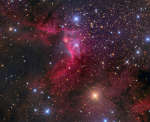 Sh2 155: The Cave Nebula
19.10.2013
This colorful skyscape features the dusty, reddish glow of Sharpless catalog emission region Sh2-155, the Cave Nebula. About 2,400 light-years away, the scene lies along the plane of our Milky Way Galaxy toward the royal northern constellation of Cepheus.
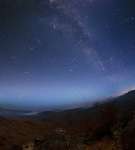 Lyrids in Southern Skies
24.04.2014
Earth's annual Lyrid meteor shower peaked before dawn on April 22nd, as our fair planet plowed through dust from the tail of long-period comet Thatcher. Even in the dry and dark Atacama desert along Chile's Pacific coast, light from a last quarter Moon made the night sky bright, washing out fainter meteor streaks.
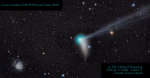 The View Toward M101
21.01.2016
Sweeping through northern skies, Comet Catalina (C/2013 US10) made its closest approach on January 17, passing about 6 light-minutes from our fair planet. Dust and ion tails clearly separated in this Earth-based view, the comet is also posed for a Messier moment, near the line-of-sight to M101, grand spiral galaxy in Ursa Major.
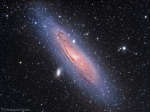 M31: The Andromeda Galaxy
27.12.2016
What is the nearest major galaxy to our own Milky Way Galaxy? Andromeda. In fact, our Galaxy is thought to look much like Andromeda. Together these two galaxies dominate the Local Group of galaxies. The diffuse light from Andromeda is caused by the hundreds of billions of stars that compose it.
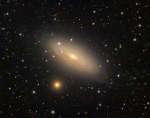 Spiral Galaxy NGC 2841
3.03.2022
A mere 46 million light-years distant, spiral galaxy NGC 2841 can be found in the northern constellation of Ursa Major. This deep view of the gorgeous island universe was captured during 32 clear nights in November, December 2021 and January 2022. It shows off a striking yellow nucleus, galactic disk, and faint outer regions.
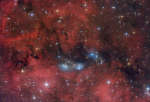 The NGC 6914 Complex
7.07.2022
A study in contrasts, this colorful skyscape features stars, dust, and glowing gas in the vicinity of NGC 6914. The interstellar complex of nebulae lies some 6,000 light-years away, toward the high-flying northern constellation Cygnus and the plane of our Milky Way Galaxy.
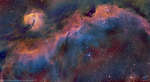 The Seagull Nebula
19.01.2023
A broad expanse of glowing gas and dust presents a bird-like visage to astronomers from planet Earth, suggesting its popular moniker - The Seagull Nebula. Using narrowband image data, this 3-panel mosaic of the cosmic...
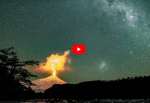 APOD: 2024 July 17 Б Villarrica Volcano Against the Sky
17.07.2024
When Vulcan, the Roman god of fire, swings his blacksmith's hammer, the sky is lit on fire. A recent eruption of Chile's Villarrica volcano shows the delicate interplay between this fire -- actually...
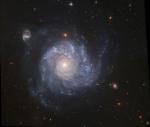 NGC 1309 and Friends
9.02.2006
A gorgeous spiral galaxy some 100 million light-years distant, NGC 1309 lies on the banks of the constellation Eridanus. NGC 1309 spans about 30,000 light-years, one third the size of our larger Milky Way galaxy.
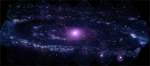 Ultraviolet Andromeda
17.09.2009
Taken by a telescope onboard NASA's Swift satellite, this stunning vista represents the highest resolution image ever made of the Andromeda Galaxy (aka M31) - at ultraviolet wavelengths. The mosaic is composed of 330 individual images covering a region 200,000 light-years wide.
|
January February March April May June July August September October |
|||||||||||||||||||||||||||||||||||||||||||||||||