
|
You entered: planets
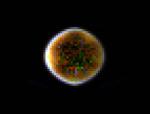 Gamma Ray Earth
31.03.2005
The pixelated planet above is actually our own planet Earth seen in gamma rays - the most energetic form of light. In fact, the gamma rays used to construct this view pack over 35 million electron volts (MeV) compared to a mere two electron volts (eV) for a typical visible light photon.
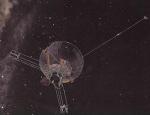 Pioneer 10: The First 6 Billion Miles
3.03.1997
Q: What was made by humans and is 6 billion miles away? A: Pioneer 10 - and yesterday was the 25th anniversary of its launch. More than 9 light hours distant, Pioneer 10 is presently about twice as far from the Sun as Pluto, bound for interstellar space at 28,000 miles per hour.
 Venus at Night in Infrared from Akatsuki
30.01.2018
Why is Venus so different from Earth? To help find out, Japan launched the robotic Akatsuki spacecraft which entered orbit around Venus late in 2015 after an unplanned five-year adventure around the inner Solar System.
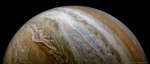 A Jupiter Vista from Juno
23.11.2020
Why do colorful cloud bands encircle Jupiter? Jupiter's top atmospheric layer is divided into light zones and dark belts that go all the way around the giant planet. It is high horizontal winds -- in excess of 300 kilometers per hour -- that cause the zones to spread out planet-wide.
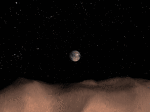 Earth Nears Asteroid Toutatis
1.10.2004
On Wednesday, September 29, the Earth came within one million miles of the asteroid Toutatis -- the closest predicted aproach of our fair planet to a sizable asteroid or comet in this century. Coming within...
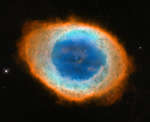 M57: The Ring Nebula
5.06.2013
Except for the rings of Saturn, the Ring Nebula (M57) is probably the most famous celestial band. Its classic appearance is understood to be due to our own perspective, though. The recent mapping...
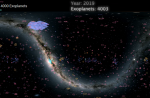 4000 Exoplanets
10.07.2019
Over 4000 planets are now known to exist outside our Solar System. Known as exoplanets, this milestone was passed last month, as recorded by NASA's Exoplanet Archive. The featured video highlights these exoplanets in sound and light, starting chronologically from the first confirmed detection in 1992.
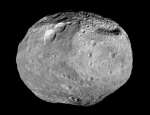 Leaving Vesta
19.09.2012
Next stop: Ceres. Last week the robotic Dawn spacecraft ended its year-long mission to asteroid Vesta, becoming the first spacecraft ever to visit this far off world located between Mars and Jupiter, in the Solar System's main asteroid belt.
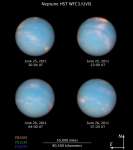 Neptune: Once Around
14.07.2011
Neptune rotates once on its axis in about 16 hours. So, spaced about 4 hours apart these 4 images of the solar system's most distant gas giant cover one Neptune day. Recorded...
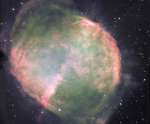 M27: Not A Comet
26.06.2008
Born on June 26th in 1730, astronomer Charles Messier scanned 18th century French skies for comets. To avoid confusion and aid his comet hunting, he diligently recorded this object as number 27 on his list of things which are definitely not comets.
|
January February |
|||||||||||||||||||||||||||||||||||||||||||||||||