
|
You entered: image
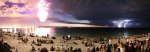 Comet Between Fireworks and Lightning
5.07.2008
Sometimes the sky itself is the best show in town. Last January, people from Perth, Australia gathered on a local beach to watch a sky light up with delights near and far. Nearby, fireworks exploded as part of Australia Day celebrations. On the far right, lightning from a thunderstorm flashed in the distance.
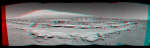 Mount Sharp on the Horizon
8.03.2014
Get out your red/blue glasses (red for the left eye) and look out over this expansive martian landscape. The panoramic stereo view is composed of images from the roving Curiosity's Navcam taken at a rest stop during a 100 meter drive on Sol 548 (February 19).
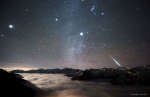 Geminid Fireball over Mount Balang
16.12.2014
This was a sky to remember. While viewing the Geminids meteor shower a few days ago, a bright fireball was captured over Mt. Balang, China with particularly picturesque surroundings. In the foreground, a sea of light clouds slowly floated between dark mountain peaks.
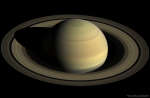 Saturn from Above
25.09.2016
This image of Saturn could not have been taken from Earth. No Earth based picture could possibly view the night side of Saturn and the corresponding shadow cast across Saturn's rings. Since Earth is much closer to the Sun than Saturn, only the day side of the ringed planet is visible from the Earth.
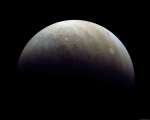 Southern Jupiter from Perijove 3
17.12.2016
Southern Jupiter looms some 37,000 kilometers away in this JunoCam image from December 11. The image data was captured near Juno's third perijove or closest approach to Jupiter, the spacecraft still in its 53 day long looping orbit.
 APOD: 2024 November 5 Б Milky Way over Easter Island
5.11.2024
Why were the statues on Easter Island built? No one is sure. What is sure is that over 900 large stone statues called moais exist there. The Rapa Nui (Easter Island) moais stand, on average, over twice as tall as a person and have over 200 times as much mass.
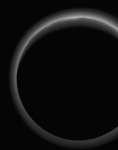 APOD: 2025 October 2 Б Pluto at Night
2.10.2025
The night side of Pluto spans this shadowy scene. In the stunning spacebased perspective, the Sun is 4.9 billion kilometers (almost 4.5 light-hours) behind the dim and distant world. It was captured by far flung New Horizons in July of 2015 when the spacecraft was at a range of some 21,000 kilometers from Pluto.
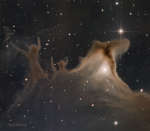 APOD: 2025 October 29 Б Dust Shapes of the Ghost Nebula
29.10.2025
Do any shapes seem to jump out at you from this interstellar field of stars and dust? The jeweled expanse, filled with faint, starlight-reflecting clouds, drifts through the night in the royal constellation of Cepheus.
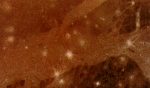 Voyager's Preview of Galileo at Ganymede
27.06.1996
NASA's robot spacecraft Galileo began its long voyage to Jupiter in October of 1989. In December of last year it arrived in the Jovian system, beginning its unprecedented, detailed exploration by dropping a probe into the gas giant's atmosphere. By early this morning it will have accomplished another milestone in its ambitious mission.
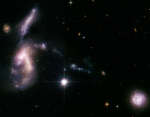 Galaxy Group Hickson 31
22.02.2010
Will the result of these galactic collisions be one big elliptical galaxy? Quite possibly, but not for another billion years. Pictured above, several of the dwarf galaxies of in the Hickson Compact Group 31 are seen slowly merging.
|
January February March April May June July August September |
|||||||||||||||||||||||||||||||||||||||||||||||||