
|
You entered: Earth's moon
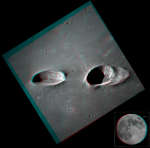 Messier Craters in Stereo
11.12.2020
Many bright nebulae and star clusters in planet Earth's sky are associated with the name of astronomer Charles Messier from his famous 18th century catalog. His name is also given to these two large and remarkable craters on the Moon.
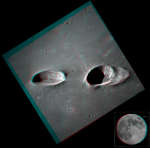 Messier Craters in Stereo
2.12.2017
Many bright nebulae and star clusters in planet Earth's sky are associated with the name of astronomer Charles Messier, from his famous 18th century catalog. His name is also given to these two large and remarkable craters on the Moon.
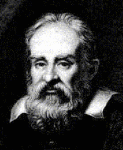 Galileo Demonstrates the Telescope
30.08.1996
Galileo Galilei made a good discovery great. Upon hearing at age 40 that a Dutch optician had invented a glass that made distant objects appear larger, Galileo crafted his own telescope and turned it toward the sky.
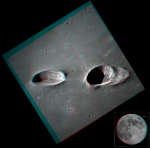 APOD: 2026 May 9 Б Messier Craters in Stereo
9.05.2026
Many bright nebulae and star clusters in planet Earth's sky are associated with the name of astronomer Charles Messier from his famous 18th century catalog. His name is also given to these two large and remarkable craters on the Moon.
 Bow Tie Moon and Star Trails
8.02.2018
On January 31, a leisurely lunar eclipse was enjoyed from all over the night side of planet Earth, the first of three consecutive total eclipses of the Moon. This dramatic time-lapse image followed the celestial performance for over three hours in a combined series of exposures from Hebei Province in Northern China.
 Moon Rocket
20.07.1999
On July 20, 1969, only four days after leaving planet Earth 250,000 miles behind them, Apollo 11 astronauts landed on the moon - the first humans to reach another celestial body. But the Saturn...
 The Lunar X
10.12.2016
The striking X appearing in this lunarscape is easily visible in binoculars or a small telescope. Yet, not too many have seen it. The catch is this lunar X is fleeting, only apparent in the hours before the Moon's first quarter phase.
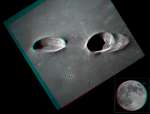 Messier Craters in Stereo
8.06.2013
Many bright nebulae and star clusters in planet Earth's sky are associated with the name of astronomer Charles Messier, from his famous 18th century catalog. His name is also given to these two large and remarkable craters on the Moon.
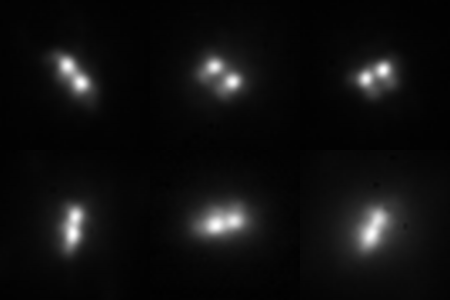 Double Asteroid 90 Antiope
1.11.2000
This eight-frame animation is based on the first ever images of a double asteroid! Formerly thought to be a single enormous chunk of rock, asteroid 90 Antiope resides in the solar system's main asteroid belt between Mars and Jupiter.
 Juno Approaching Jupiter
1.07.2016
Approaching over the north pole after nearly a five-year journey, Juno enjoys a perspective on Jupiter not often seen, even by spacecraft from Earth that usually swing by closer to Jupiter's equator. Looking...
|
January February March April May June July August September |
|||||||||||||||||||||||||||||||||||||||||||||||||