
|
You entered: massive stars
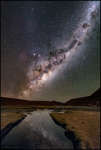 The Altiplano Night
7.07.2016
The Milky Way is massively bright on this cold, clear, altiplano night. At 4,500 meters its reflection in a river, a volcanic peak on the distant horizon, is captured in this stitched panorama under naturally dark skies of the northern Chilean highlands near San Pedro de Atacama.
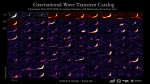 Ninety Gravitational Wave Spectrograms and Counting
7.12.2021
Every time two massive black holes collide, a loud chirping sound is broadcast out into the universe in gravitational waves. Humanity has only had the technology to hear these unusual chirps for the past seven years, but since then we have heard about 90 -- during the first three observing runs.
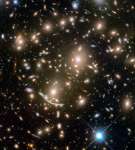 Galaxy Cluster Abell 370 and Beyond
6.05.2017
Some 4 billion light-years away, massive galaxy cluster Abell 370 only appears to be dominated by two giant elliptical galaxies and infested with faint arcs in this sharp Hubble Space Telescope snapshot. The fainter...
 Galaxy Cluster Abell 370 and Beyond
12.09.2023
Some 4 billion light-years away, massive galaxy cluster Abell 370 is captured in this sharp Hubble Space Telescope snapshot. The cluster of galaxies only appears to be dominated by two giant elliptical galaxies and infested with faint arcs.
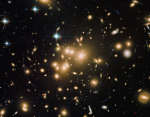 Galaxy Cluster Abell 1689 Deflects Light
17.09.2013
It is one of the most massive objects in the visible universe. In this view from the Hubble Space Telescope's Advanced Camera for Surveys, Abell 1689 is seen to warp space as predicted by Einstein's theory of gravity -- deflecting light from individual galaxies which lie behind the cluster to produce multiple, curved images.
 The Supermassive Black Holes of NGC 6240
28.11.2002
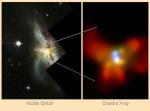
The Hubble optical image on the left shows NGC 6240 in the throes of a titanic galaxy - galaxy collision 400 million light-years away. As the cosmic catastrophe plays out, the merging galaxies spew forth distorted tidal tails of stars, gas, and dust and undergo frantic bursts of star formation.
 Horsehead: A Wider View
3.05.2013
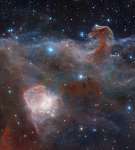
Combined image data from the massive, ground-based VISTA telescope and the Hubble Space Telescope was used to create this wide perspective of the interstellar landscape surrounding the famous Horsehead Nebula. Captured at near-infrared wavelengths...
 Horsehead: A Wider View
9.03.2018
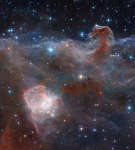
Combined image data from the massive, ground-based VISTA telescope and the Hubble Space Telescope was used to create this wide perspective of the interstellar landscape surrounding the famous Horsehead Nebula. Captured at near-infrared wavelengths...
|
January February March April May June July August September |
|||||||||||||||||||||||||||||||||||||||||||||||||