
|
You entered: camera
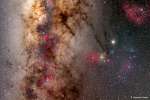 A Scorpius Sky Spectacular
4.05.2014
If Scorpius looked this good to the unaided eye, humans might remember it better. Scorpius more typically appears as a few bright stars in a well-known but rarely pointed out zodiacal constellation. To get a spectacular image like this, though, one needs a good camera, color filters, and a digital image processor.
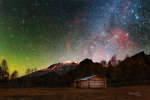 The Gum Nebula over Snowy Mountains
26.06.2022
The Gum Nebula is so large and close it is actually hard to see. This interstellar expanse of glowing hydrogen gas frequently evades notice because it spans 35 degrees -- over 70 full Moons -- while much of it is quite dim.
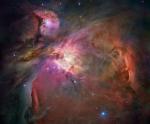 Orion Nebula, The Hubble View
18.01.2006
Few cosmic vistas excite the imagination like the Orion Nebula. Also known as M42, the nebula's glowing gas surrounds hot young stars at the edge of an immense interstellar molecular cloud only 1,500 light-years away.
Circumpolarv2comentada1024.preview.jpg) Polaris and the Trail of Comet ZTF
Polaris and the Trail of Comet ZTF
2.02.2023
Stars trace concentric arcs around the North Celestial Pole in this three hour long night sky composite, recorded with a digital camera fixed to a tripod on January 31, near цger, Lleida, Spain. On that date Comet C/2022 E3 (ZTF) was near its northernmost declination in planet Earth's sky.
 APOD: 2024 February 19 Б Looking Sideways from the Parker Solar Probe
18.02.2024
What's happening near the Sun? To help find out, NASA launched the robotic Parker Solar Probe (PSP) to investigate regions closer to the Sun than ever before. The PSP's looping orbit brings it nearer to the Sun each time around -- every few months.
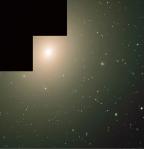 Young Star Clusters in an Old Galaxy
4.07.2002
Elliptical galaxy NGC 4365 is old, probably about 12 billion years old. Like most elliptical galaxies, this galaxy was thought to be full of old stars too, its burst of star forming activity having long since ended.
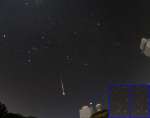 Leonid Fireball over Tenerife
22.11.2011
Historically active, this year's Leonid meteor shower was diminished by bright moonlight. Still, faithful night sky watchers did see the shower peak on November 18 and even the glare of moonlight didn't come close to masking this brilliant fireball meteor.
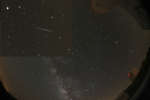 A Twisted Meteor Trail Over Tenerife
2.06.2010
Did this meteor take a twisting path? No one is sure. Considered opinions are solicited. Meteors, usually sand sized grains that originate in comets, will typically disintegrate as they enter the Earth's atmosphere. A fast moving meteor ionizes molecules in the Earth's atmosphere that subsequently glow when they reacquire electrons.
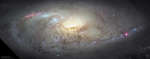 M106 Close Up
3.10.2013
Close to the Great Bear (Ursa Major) and surrounded by the stars of the Hunting Dogs (Canes Venatici), this celestial wonder was discovered in 1781 by the metric French astronomer Pierre Mechain. Later, it was added to the catalog of his friend and colleague Charles Messier as M106.
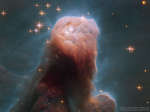 The Cone Nebula from Hubble
14.03.2017
Stars are forming in the gigantic dust pillar called the Cone Nebula. Cones, pillars, and majestic flowing shapes abound in stellar nurseries where natal clouds of gas and dust are buffeted by energetic winds from newborn stars. The Cone Nebula, a well-known example, lies within the bright galactic star-forming region NGC 2264.
|
January February March April May June July August September |
|||||||||||||||||||||||||||||||||||||||||||||||||