
|
You entered: Milky Way
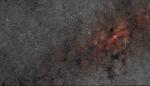 The Galactic Center in Infrared
21.06.1999
The center of our Galaxy is a busy place. In visible light, much of the Galactic Center is obscured by opaque dust. In infrared light, however, dust glows more and obscures less, allowing nearly one million stars to be recorded in the above photograph.
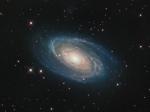 Bright Galaxy M81
7.07.2006
Big and beautiful spiral galaxy M81 lies in the northern constellation Ursa Major. One of the brightest galaxies in planet Earth's sky, M81 is also home to the second brightest supernova seen in modern times.
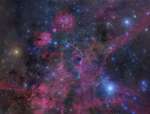 Vela Supernova Remnant
6.03.2008
The plane of our Milky Way Galaxy runs through this complex and beautiful skyscape. At the northwestern edge of the constellation Vela (the Sails) the 16 degree wide, 30 frame mosaic is centered on the glowing filaments of the Vela Supernova Remnant, the expanding debris cloud from the death explosion of a massive star.
 NGC 3621: Far Beyond the Local Group
19.09.2009
Far beyond the local group of galaxies lies NGC 3621, some 22 million light-years away. Found in the multi-headed southern constellation Hydra, the winding spiral arms of this gorgeous island universe are loaded with luminous young star clusters and dark dust lanes.
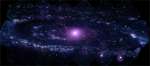 Ultraviolet Andromeda
27.10.2010
This stunning vista represents the highest resolution image ever made of the Andromeda Galaxy (aka M31) at ultraviolet wavelengths. Recorded by NASA's Swift satellite, the mosaic is composed of 330 individual images covering a region 200,000 light-years wide.
 Sisters of the Dusty Sky
18.11.2010
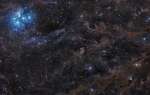
Hurtling through a cosmic dust cloud some 400 light-years away, the lovely Pleiades or Seven Sisters star cluster is well-known for its striking blue reflection nebulae. In the dusty sky toward the constellation Taurus and the Orion Arm of our Milky Way Galaxy, this remarkable image shows the famous star cluster at the upper left.
 Stars, Sprites, Clouds, Auroras
3.02.2015
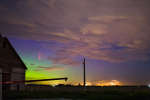
What are those red streaks in the sky? While photographing unexpected auroras over a distant thunderstorm, something extraordinary happened: red sprites. This brief instance of rarely imaged high-altitude lightning flashed so bright that it was witnessed by several people independently.
 Behold the Universe
3.08.2016
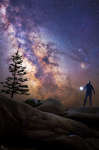
What if you climbed up on a rock and discovered the Universe? You can. Although others have noted much of it before, you can locate for yourself stars, planets, and even the plane of our Milky Way Galaxy. All you need is a dark clear sky -- the rock is optional.
 Five Hundred Meter Aperture Spherical Telescope
29.09.2016
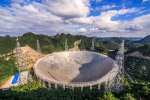
The Five-hundred-meter Aperture Spherical Telescope (FAST) is nestled within a natural basin in China's remote and mountainous southwestern Guizhou province. Nicknamed Tianyan, or the Eye of Heaven, the new radio telescope is seen in this photograph taken near the start of its testing phase of operations on September 25.
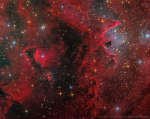 IC 1871: Inside the Soul Nebula
28.11.2018
This cosmic close-up looks deep inside the Soul Nebula. The dark and brooding dust clouds on the left, outlined by bright ridges of glowing gas, are cataloged as IC 1871. About 25 light-years across, the telescopic field of view spans only a small part of the much larger Heart and Soul nebulae.
|
January February March April May June July August September October |
|||||||||||||||||||||||||||||||||||||||||||||||||