
|
You entered: star cluster
 Messier 24: Sagittarius Star Cloud
28.06.2023
Unlike most entries in Charles Messier's famous catalog of deep sky objects, M24 is not a bright galaxy, star cluster, or nebula. It's a gap in nearby, obscuring interstellar dust clouds that allows a view of the distant stars in the Sagittarius spiral arm of our Milky Way galaxy.
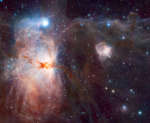 The Flame Nebula in Infrared
12.01.2010
What lights up the Flame Nebula? Fifteen hundred light years away towards the constellation of Orion lies a nebula which, from its glow and dark dust lanes, appears, on the left, like a billowing fire. But fire, the rapid acquisition of oxygen, is not what makes this Flame glow.
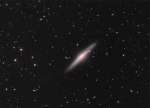 NGC 2683: Edge On Spiral Galaxy
17.03.2012
This elegant island universe is cataloged as NGC 2683. It lies a mere 16 million light-years distant toward the northern constellation Lynx. A spiral galaxy comparable to our own Milky Way, NGC 2683 is seen nearly edge-on in the cosmic vista.
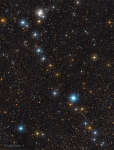 APOD: 2023 January 3 Б Kembles Cascade of Stars
3.01.2023
This line of stars is real. A little too faint to see with the unaided eye, KembleБs Cascade of stars inspires awe when seen with binoculars. Like the Big Dipper though, KembleБs Cascade is an asterism, not a constellation. The asterism is visible in the northern sky toward the long-necked constellation of the Giraffe (Camelopardalis).
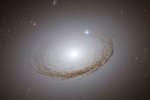 Unusual Dusty Galaxy NGC 7049
8.04.2009
How was this unusual looking galaxy created? No one is sure, especially since spiral galaxy NGC 7049 looks so strange. NGC 7049's strikingly appearance is primarily due to an unusually prominent dust ring seen mostly in silhouette. The opaque ring is much darker than the din of millions of bright stars glowing behind it.
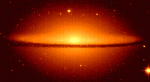 M104: The Sombrero Galaxy
9.11.1995
The famous Sombrero galaxy (M104) is a bright nearby spiral galaxy. The prominent dust lane and halo of stars and globular clusters give this galaxy its name. Something very energetic is going on in the Sombrero's center, as much X-ray light has been detected from it.
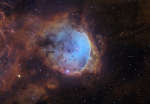 NGC 3324 in Carina
6.04.2018
This bright cosmic cloud was sculpted by stellar winds and radiation from the hot young stars of open cluster NGC 3324. With dust clouds in silhouette against its glowing atomic gas, the pocket-shaped star-forming region actually spans about 35 light-years. It lies some 7,500 light-years away toward the nebula rich southern constellation Carina.
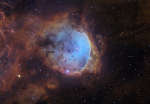 NGC 3324 in Carina
16.03.2019
This bright cosmic cloud was sculpted by stellar winds and radiation from the hot young stars of open cluster NGC 3324. With dust clouds in silhouette against its glowing atomic gas, the pocket-shaped star-forming region actually spans about 35 light-years. It lies some 7,500 light-years away toward the nebula rich southern constellation Carina.
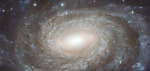 NGC 6384: Spiral Beyond the Stars
6.07.2013
The universe is filled with galaxies. But to see them astronomers must look out beyond the stars of our own galaxy, the Milky Way. This colorful Hubble Space Telescopic portrait features spiral galaxy NGC 6384, about 80 million light-years away in the direction of the constellation Ophiuchus.
 Messier 24: Sagittarius Star Cloud
18.07.2024
Unlike most entries in Charles Messier's famous catalog of deep sky objects, M24 is not a bright galaxy, star cluster, or nebula. It's a gap in nearby, obscuring interstellar dust clouds that allows a view of the distant stars in the Sagittarius spiral arm of our Milky Way galaxy.
|
January February March April May |
|||||||||||||||||||||||||||||||||||||||||||||||||