
|
You entered: surface
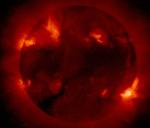 Solstice Sun In Soft X-rays
21.12.1998
The solstice occurs today at 8:56 PM Eastern Standard Time. At the solstice the sun reaches its most southerly position in the sky and winter begins for the Northern Hemisphere while summer starts South of the Equator.
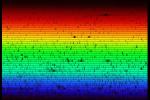 The Solar Spectrum
27.02.2005
It is still not known why the Sun's light is missing some colors. Shown above are all the visible colors of the Sun, produced by passing the Sun's light through a prism-like device.
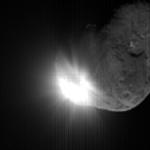 Thirteen Seconds After Impact
5.07.2005
Fireworks came early on July 4th when, at 1:52am EDT, the Deep Impact spacecraft's probe smashed into the surface of Comet Tempel 1's nucleus at ten kilometers per second. The well-targeted impactor probe was vaporized as it blasted out an expanding cloud of material, seen here 13 seconds after the collision.
 Martian Chiaroscuro
29.08.2020
Deep shadows create dramatic contrasts between light and dark in this high-resolution close-up of the martian surface. Recorded on January 24, 2014 by the HiRISE camera on board the Mars Reconnaissance Orbiter, the scene spans about 1.5 kilometers.
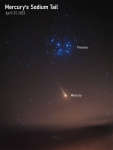 Mercurys Sodium Tail
3.05.2022
That's no comet. Below the Pleiades star cluster is actually a planet: Mercury. Long exposures of our Solar System's innermost planet may reveal something unexpected: a tail. Mercury's thin atmosphere contains small amounts of sodium that glow when excited by light from the Sun.
 Rock Fingers on Mars
20.06.2022
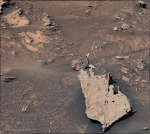
There, just right of center, what is that? The surface of Mars keeps revealing new surprises with the recent discovery of finger-like rock spires. The small nearly-vertical rock outcrops were imaged last month by the robotic Curiosity rover on Mars.
 3D Ingenuity
24.06.2023
The multicolor, stereo imaging Mastcam-Z on the Perseverance rover zoomed in to capture this 3D close-up (get out your red/blue glasses) of the Mars Ingenuity helicopter on mission sol 45. That's Earth-date 2021 April 5.
 Mars Pathfinder Super Pan
10.10.1997
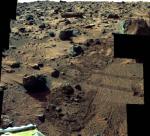
Spectacular details of rover tracks, wind-driven soil, and textured rocks on the Martian surface fill this color mosaic. The view is north-northeast from the Sagan Memorial Station at the Pathfinder landing site on Mars.
 Apollo 16: Exploring Plum Crater
20.12.1997
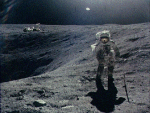
Apollo 16 spent three days on Earth's Moon in April 1972. The fifth lunar landing mission out of six, Apollo 16 was famous for deploying and using an ultraviolet telescope as the first lunar observatory, and for collecting rocks and data on the mysterious lunar highlands. In the above picture, astronaut John W.
 Small Moon Epimetheus
29.04.2005
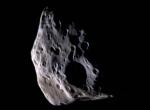
Small saturnian moon Epimetheus (ep-ee-MEE-thee-us) is at most 116 kilometers across. Its cratered surface and irregular shape are highlighted by dramatic shadows in this composite close-up image from the Cassini spacecraft. However, orbiting 91,000 kilometers above Saturn's cloud tops, Epimetheus is not alone.
|
January February March April May June July August September October |
|||||||||||||||||||||||||||||||||||||||||||||||||