
|
You entered: Earth's moon
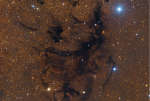 LDN 673: Dark Clouds in Aquila
29.10.2022
Part of a dark expanse that splits the crowded plane of our Milky Way galaxy, the Aquila Rift arcs through planet Earth's skies near bright star Altair. In eerie silhouette against the Milky...
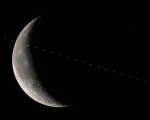 Trifecta at Twilight
20.02.2020
On February 18, as civil twilight began in northern New Mexico skies, the International Space Station, a waning crescent Moon, and planet Mars for a moment shared this well-planned single field of view. From...
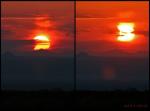 Touran Sunrise
23.03.2007
Clouds covered the eastern horizon on Monday, when the Sun rose over the expansive Touran Wildlife Reserve in northeastern Iran. Of course, on that day the Moon rose with the Sun, creating a widely enjoyed partial solar eclipse.
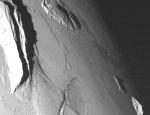 Io at Sunset
20.01.2003
How tall are mountains on Jupiter's moon Io? One way to find out is to view them at sunset. Tall structures facing the Sun are then better-lit and cast long shadows. The above...
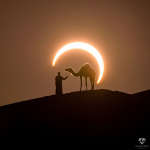 Solar Eclipse over the UAE
10.02.2020
What's happening behind that camel? A partial eclipse of the Sun. About six and a half weeks ago, the Moon passed completely in front of the Sun as seen from a narrow band on the Earth.
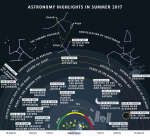 Highlights of the Summer Sky
5.06.2017
What's up in the sky this summer? The featured graphic gives a few highlights for Earth's northern hemisphere. Viewed as a clock face centered at the bottom, early summer sky events fan out toward the left, while late summer events are projected toward the right.
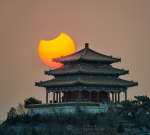 Partial Eclipse over Beijing
11.01.2019
On January 6 the New Moon rose in silhouette with the Sun seen from northeastern Asia. Near maximum, the dramatic partial solar eclipse is captured in this telephoto view through hazy skies. In the foreground, the hill top Wanchun pavilion overlooking central Beijing's popular Forbidden City hosts eclipse-watching early morning risers.
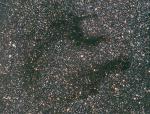 The E Nebula in Aquila
20.08.2003
Several unusual strands of darkness are prominent toward the constellation of Aquila. This particular dark nebula is known as the E Nebula, for its evocative shape, or B142 and B143, for its position(s) on a list of such nebula compiled by Barnard.
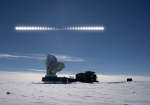 Postcard from the South Pole
11.12.2021
From this vantage point about three quarters of a mile from planet Earth's geographic South Pole, the December 4 eclipse of the Sun was seen as a partial eclipse. At maximum eclipse the New Moon blocked 90 percent of the solar disk.
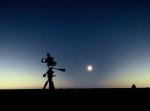 Shadow Cone of a Total Solar Eclipse
6.01.2003
Sometimes, during a total eclipse of the Sun, a strange shadow of darkness can be seen stretching off into the distance. Called a shadow cone, they are visible because the Earth's atmosphere is not completely transparent, scattering sunlight and hence appearing blue during the day.
|
January February March April May June July August September |
|||||||||||||||||||||||||||||||||||||||||||||||||