
|
You entered: neutron star
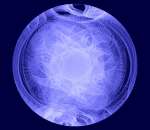 Fermi Epicyles: The Vela Pulsar s Path
4.05.2012
Exploring the cosmos at extreme energies, the Fermi Gamma-ray Space Telescope orbits planet Earth every 95 minutes. By design, it rocks to the north and then to the south on alternate orbits in order to survey the sky with its Large Area Telescope (LAT).
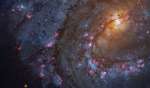 In the Arms of M83
11.11.2011
Big, bright, and beautiful, spiral galaxy M83 lies a mere twelve million light-years away, near the southeastern tip of the very long constellation Hydra. This cosmic close-up, a mosaic based on data from...
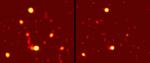 The High Energy Heart Of The Milky Way
29.07.1998
These high resolution false color pictures of the Galactic center region in high energy X-ray and gamma-ray light result from a very long exposure of roughly 3,000 hours performed from 1990 to 1997 by the French SIGMA telescope onboard the Russian GRANAT spacecraft.
 M83: The Southern Pinwheel
16.01.2025
Beautiful and bright spiral galaxy M83 lies a some twelve million light-years away, near the southeastern tip of the very long constellation Hydra. Prominent spiral arms traced by dark dust lanes and blue star clusters lend this galaxy its popular name, The Southern Pinwheel.
 Fermi s Gamma ray Pulsars
9.07.2009
Born in supernovae, pulsars are spinning neutron stars, collapsed stellar cores left from the death explosions of massive stars. Traditionally identified and studied by observing their regular radio pulsations, two dozen pulsars have now been detected at extreme gamma-ray energies by the Fermi Gamma-ray Space Telescope.
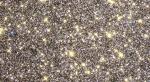 The Center of Globular Cluster Omega Centauri
10.10.2001
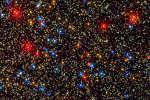
What is left over after stars collide? To help answer this question, astronomers have been studying the center of the most massive ball of stars in our Milky Way Galaxy. In the center of globular cluster Omega Centauri, stars are packed in 10,000 times more densely than near our Sun.
 The Center of Globular Cluster Omega Centauri
14.09.2009
What is left over after stars collide? To help answer this question, astronomers have been studying the center of the most massive ball of stars in our Milky Way Galaxy. In the center of globular cluster Omega Centauri, stars are packed in 10,000 times more densely than near our Sun.
 The Mysterious Rings of Supernova 1987A
5.03.2017
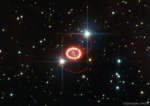
What's causing those odd rings in supernova 1987A? Thirty years ago, in 1987, the brightest supernova in recent history was seen in the Large Magellanic Cloud. At the center of the featured picture is an object central to the remains of the violent stellar explosion.
 The Mysterious Rings of Supernova 1987A
26.02.2012
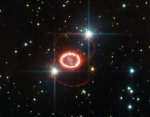
What's causing those odd rings in supernova 1987A? Twenty five years ago, in 1987, the brightest supernova in recent history was seen in the Large Magellanic Clouds. At the center of the above picture is an object central to the remains of the violent stellar explosion.
 The Decade that Defined Star System
29.12.1999
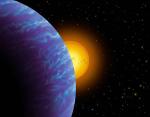
As the 1990s began, the only planetary star system known was our own Solar System. The first extra-solar star system was discovered orbiting a pulsar in 1991. Slight changes in the precise arrival times of the pulses from the central small dense neutron star gave evidence of orbiting planets.
|
January February March April May June July August September October |
|||||||||||||||||||||||||||||||||||||||||||||||||