
|
You entered: magellanic clouds
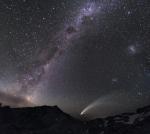 Three Galaxies and a Comet
30.03.2007
Diffuse starlight and dark nebulae along the southern Milky Way arc over the horizon and sprawl diagonally through this gorgeous nightscape. The breath-taking mosaic spans a wide 100 degrees, with the rugged terrain of the Patagonia, Argentina region in the foreground.
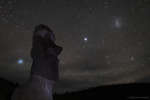 Stars Over Easter Island
12.10.2009
Why were the statues on Easter Island built? No one is sure. What is sure is that over 800 large stone statues exist there. The Easter Island statues, stand, on the average, over twice as tall as a person and have over 200 times as much mass.
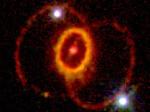 The Mysterious Rings of Supernova 1987A
6.01.2007
What's causing those odd rings in supernova 1987A? In 1987, the brightest supernova in recent history occurred in the Large Magellanic Clouds. At the center of the picture is an object central to the remains of the violent stellar explosion.
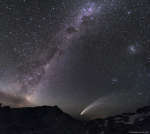 Three Galaxies and a Comet
13.01.2018
Diffuse starlight and dark nebulae along the southern Milky Way arc over the horizon and sprawl diagonally through this gorgeous nightscape. The breath-taking mosaic spans a wide 100 degrees, with the rugged terrain of the Patagonia, Argentina region in the foreground.
 Superbubbles in the LMC
3.07.1996
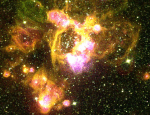
Why is there a hole in the center of this nebula? A leading explanation is that it is caused by the stellar winds from the stars that live there. Stars - including the Sun - expel electrons, protons, and other charged ions in a steady stream - the stellar wind.
 Star Cluster R136 Breaks Out
9.01.2021
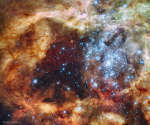
In the center of nearby star-forming region lies a huge cluster containing some of the largest, hottest, and most massive stars known. These stars, known collectively as star cluster R136, part of the Tarantula Nebula, were captured in the featured image in visible light in 2009 through the Hubble Space Telescope.
 Star Cluster R136 Bursts Out
6.05.2007
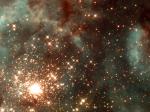
In the center of star-forming region 30 Doradus lies a huge cluster of the largest, hottest, most massive stars known. These stars, known as the star cluster R136, and part of the surrounding nebula are captured here in this gorgeous visible-light image from the Hubble Space Telescope.
 NGC 206 and the Star Clouds of Andromeda
25.09.2014
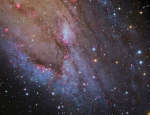
The large stellar association cataloged as NGC 206 is nestled within the dusty arms of the neighboring Andromeda galaxy. Also known as M31, the spiral galaxy is a mere 2.5 million light-years away.
 A Sky Portal in New Zealand
29.07.2014
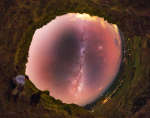
To some, it may look like a portal into the distant universe. To others, it may appear as the eye of a giant. Given poetic license, both are correct. Pictured above is a standard fisheye view of the sky -- but with an unusual projection.
 N81: Starbirth in the SMC
27.07.1998
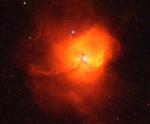
A very young star cluster has been discovered in a neighboring galaxy. The stars found in this cluster, dubbed N81, are so young and massive that they furiously eject matter and light up the surrounding nebula. The ejected stellar winds combine and interact to sculpt beautiful and complex structures.
|
January February March April May June July August September |
|||||||||||||||||||||||||||||||||||||||||||||||||