
|
You entered: globular cluster
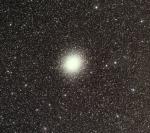 Omega Centauri
26.05.2006
Centaurus, the Centaur, is one of the most striking constellations in the southern sky. The Milky Way flows through this celestial expanse whose wonders also include the closest star to the sun, Alpha Centauri, and the largest globular star cluster in our galaxy, Omega Centauri.
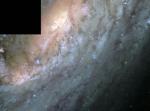 Barred Spiral Galaxy NGC 2903
20.03.2001
NGC 2903 is a spiral galaxy similar to our own Milky Way Galaxy. Similarities include its general size and a central bar. One striking difference, however, is the appearance of mysterious hot spots in NGC 2903's core. Upon
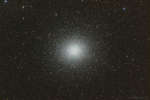 Millions of Stars in Omega Centauri
29.05.2014
Globular star cluster Omega Centauri, also known as NGC 5139, is some 15,000 light-years away. The cluster is packed with about 10 million stars much older than the Sun within a volume about...
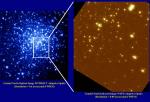 NGC 6934 from Gemini North
30.06.1999
What's going on near the center of globular cluster NGC 6934? The blur caused by the Earth's atmosphere has prevented astronomers from discerning individual stars in this unusual environment. Telescopes in space can help, but the new Gemini North telescope took the above picture from the ground.
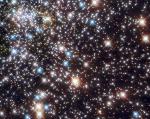 Oddities of Star Cluster NGC 6397
19.02.2002
One of these stars is blinking. This star, a member of globular cluster NGC 6397, is noteworthy not just because it blinks, but because it blinks so fast and because its companion star is so atypical.
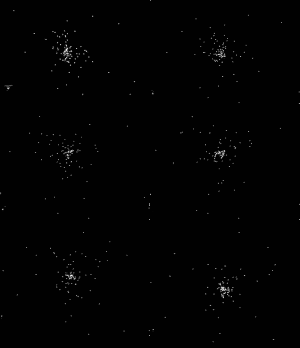 A Star Cluster in Motion
30.07.2002
Star clusters are a swarm of complex motions. The stars that compose globular clusters and many open clusters all orbit the cluster center, occasionally interacting, gravitationally, with a close-passing star. The orbits of stars around the cluster are typically not as circular as the orbits of planets in our solar system.
 NGC 2419 Intergalactic Wanderer
3.06.2015
Three objects stand out in this thoughtful telescopic image, a view toward the mostly stealthy constellation Lynx. The two brightest (the spiky ones) are nearby stars. The third is the remote globular star cluster NGC 2419, at distance of nearly 300,000 light-years.
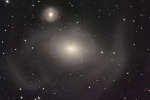 NGC 1316: After Galaxies Collide
2.09.2008
Astronomers turn detectives when trying to figure out the cause of startling sights like NGC 1316. Their investigation indicates that NGC 1316 is an enormous elliptical galaxy that started, about 100 million years ago, to devour a smaller spiral galaxy neighbor, NGC 1317, just above it.
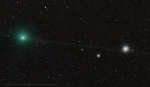 APOD: 2026 August 8 Б A Messier Moment for Tempel 2
7.08.2026
Which of these is not a comet? You guessed it - the one on the right is a globular star cluster. The diffuse greenish coma of periodic comet 10P/Tempel 2 is at left in the frame.
 Comet Garradd Passes Ten Thousand Stars
3.09.2011
Comet Garradd continues to brighten as it drifts across the northern sky. Last week the comet, visible with binoculars and discernable by its green coma, passed nearly in front of globular cluster M71.
|
January February March April May June July August |
||||||||||||||||||||||||||||||||||||||||||||||||||||||||