
|
You entered: dwarf planet
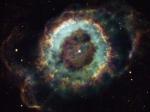 NGC 6369: The Little Ghost Nebula
8.11.2002
This pretty planetary nebula, cataloged as NGC 6369, was discovered by 18th century astronomer William Herschel as he used a telescope to explore the constellation Ophiucus. Round and planet-shaped, the nebula is also relatively faint and has acquired the popular moniker of Little Ghost Nebula.
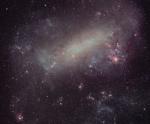 The Large Cloud of Magellan
2.09.2004
Portuguese navigator Fernando de Magellan and his crew had plenty of time to study the southern sky during the first circumnavigation of planet Earth. As a result, two fuzzy cloud-like objects easily visible for southern hemisphere skygazers are known as the Clouds of Magellan.
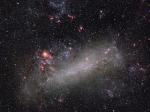 The Large Cloud of Magellan
10.05.2006
Portuguese navigator Fernando de Magellan and his crew had plenty of time to study the southern sky during the first circumnavigation of planet Earth. As a result, two fuzzy cloud-like objects easily visible for southern hemisphere skygazers are known as the Clouds of Magellan.
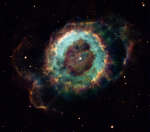 NGC 6369: The Little Ghost Nebula
28.10.2017
Wraithlike NGC 6369 is a faint apparition in night skies popularly known as the Little Ghost Nebula. It was discovered by 18th century astronomer Sir William Herschel as he used a telescope to explore the medicinal constellation Ophiucus. Herschel historically classified the round and planet-shaped nebula as a Planetary Nebula.
 Four Supernova Remnants
28.07.2006
These four panels show x-ray images of expanding cosmic debris clouds, tens of light-years across, in nearby galaxy the Large Magellanic Cloud. The supernova remnants (SNRs) are the results of two types of stellar...
 Magellanic Clouds over Chile
11.02.2023
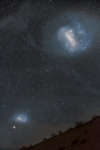
The two prominent clouds in this Chilean Atacama Desert skyscape captured on January 21 actually lie beyond our Milky Way galaxy. Known as the Large and the Small Magellanic Clouds they are so named for the 16th century Portuguese explorer Ferdinand Magellan, leader of the first circumnavigation of planet Earth.
 The Small Cloud of Magellan
5.01.2021
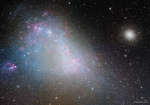
What is the Small Magellanic Cloud? It has turned out to be a galaxy. People who have wondered about this little fuzzy patch in the southern sky included Portuguese navigator Ferdinand Magellan...
 Shapley 1: An Annular Planetary Nebula
25.06.2000
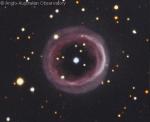
What happens when a star runs out of nuclear fuel? The center condenses into a white dwarf while the outer atmospheric layers are expelled into space and appear as a planetary nebula. This particular planetary nebula, designated Shapley 1 after the famous astronomer Harlow Shapley, has a very apparent annular ring like structure.
 Shapley 1: An Annular Planetary Nebula
15.02.1997
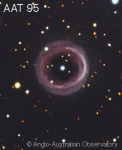
What happens when a star runs out of nuclear fuel? The center condenses into a white dwarf while the outer atmospheric layers are expelled into space and appear as a planetary nebula. This particular planetary nebula, designated Shapley 1 after the famous astronomer Harlow Shapley, has a very apparent annular ring like structure.
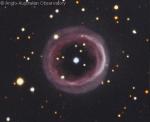 Shapley 1: An Annular Planetary Nebula
9.08.1998
What happens when a star runs out of nuclear fuel? The center condenses into a white dwarf while the outer atmospheric layers are expelled into space and appear as a planetary nebula. This particular planetary nebula, designated Shapley 1 after the famous astronomer Harlow Shapley, has a very apparent annular ring like structure.
|
January February March April May June July August |
||||||||||||||||||||||||||||||||||||||||||||||||||||||||